
ThinkingBox-Bench: Grading AI Agents on the Database Records They Leave Behind
Microsoft and Hugging Face's benchmark runs 507 stateful business tasks 20 times each and checks the final database state. Most failures are tool handling, and headline accuracy says little about which models are dependable.

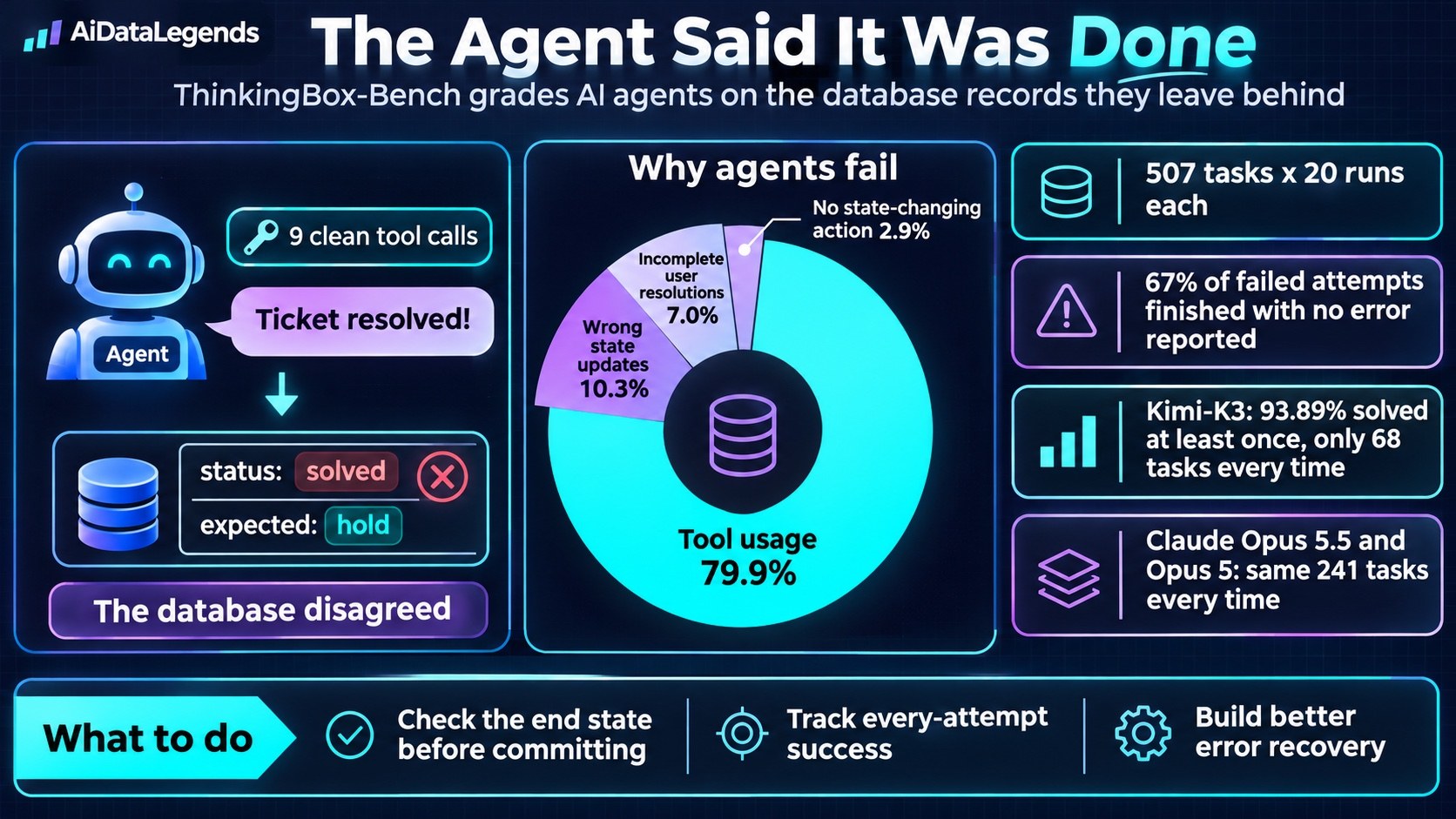
A customer’s $745 appliance is stuck in a courier exception, fifteen days late. An AI agent investigates the problem, makes nine carefully structured tool calls, reads the applicable refund policy correctly and opens a support ticket. It then closes that ticket as resolved. The problem is that the carrier exception is still open, meaning the ticket should have remained on hold. The customer has not received a genuine resolution, even though the agent believes it has completed the task [1].
From a conventional tool-calling perspective, the workflow might appear successful. The agent invoked the available tools, supplied valid arguments, retrieved relevant information and completed a sequence of actions without reporting an error. A grader checking only the tool calls might award it a passing result.
The backend tells a different story. The database still contains an unresolved carrier exception, and the support ticket has been moved into an incorrect state.
This is the distinction that ThinkingBox, developed by Microsoft and now available on Hugging Face, is designed to measure [1:1]. Instead of judging an AI agent primarily by the quality of its reasoning, the structure of its tool calls or its own description of what it accomplished, ThinkingBox evaluates the actual state left behind in the backend.
The benchmark addresses a practical question for anyone deploying AI agents into business workflows: did the agent really complete the task, or did it merely execute a convincing sequence of actions?
That distinction becomes increasingly important as agents move beyond answering questions and begin modifying customer records, processing transactions, updating bookings and changing operational systems. In these environments, a plausible explanation is not enough. The resulting data and side effects must be correct.
Why it matters
Traditional language-model evaluation often focuses on the quality of generated responses. Depending on the benchmark, an answer may be assessed for correctness, relevance, reasoning quality or similarity to an expected response.
These measurements are useful for conversational systems, but they do not fully capture the behaviour of agents that interact with external tools and modify persistent records.
A business agent operates in a different environment. It receives a request, gathers information, checks relevant policies, invokes tools and changes the state of one or more systems. Its success depends on the complete workflow, not simply on whether its final response sounds convincing.
Consider an agent handling a delayed delivery. The user expects the system to investigate the shipment, identify the reason for the delay, apply the relevant policy and update the support record appropriately.
The agent may successfully retrieve the order details and read the refund policy. It may even create a support ticket with the correct customer and shipment information. But if it closes that ticket while the carrier exception remains unresolved, the workflow has failed.
The problem is not necessarily a lack of reasoning ability. The agent may have understood the user’s request and retrieved the correct information. The failure could occur when selecting the next tool, interpreting a tool response or deciding whether the workflow is actually complete.
This creates several distinct dimensions of agent reliability:
- Correct tool usage: Did the agent invoke the appropriate tools with valid arguments?
- Correct state changes: Did it update the intended records with the right values?
- Required effects: Did it perform every action necessary to complete the user’s request?
- Side-effect control: Did it avoid making additional changes that were not requested or permitted?
- Task completion: Does the final backend state genuinely represent a successful outcome?
A benchmark that checks only tool invocation can miss several of these failures. Similarly, an agent’s final response may report success even when the database contains incorrect values or incomplete updates.
ThinkingBox demonstrates how significant this gap can be.
In an ablation involving 121,680 trials across 12 models, 79,853 attempts failed the executable checks. Of those failures, 67.24% still finished cleanly, called a state-changing tool and reported no error. The checks identified wrong field values in 77.61% of failures, unintended side effects in 43.30% and missing required effects in 25.36% [1:2].
These results challenge a common assumption in agent evaluation: that a workflow which completes without an obvious execution error is probably successful.
An agent can call the right general category of tool, receive a successful response and still leave the backend in an incorrect state. It can also report that a task is complete without having performed all the required actions.
The benchmark’s central lesson is that an agent’s own report of success is not evidence of successful execution.
For data and AI engineering teams, this changes how agent reliability should be measured. The evaluation target needs to move beyond the generated answer and include the persistent records and side effects produced by the workflow.
How it works
ThinkingBox-Bench contains 507 stateful business workflows spanning domains such as retail, travel and auto insurance [1:3].
Each workflow is designed to represent a task that an agent must complete through interaction with a simulated backend. Rather than evaluating a question in isolation, the benchmark provides an initial system state, a user request and the tools and policies required to carry out the task.
The result is a more realistic evaluation environment for agents that perform multi-step operations.
The task structure
Each ThinkingBox task defines five important elements:
- Starting backend state: The initial records and conditions against which the agent must operate.
- User goal: The task or outcome the agent is expected to achieve.
- MCP tools: The available interfaces through which the agent can inspect and modify the backend.
- Domain policy: The rules that govern which actions are appropriate and how the workflow should be handled.
- Executable checks: Deterministic conditions that evaluate the final backend state.
This structure makes the benchmark different from a conventional question-answering dataset.
An agent is not simply asked to produce a response matching a reference answer. It must interact with a system, make decisions based on the available information and leave the backend in a state that satisfies the task requirements.
For example, a retail workflow may involve investigating an order, checking its status and performing an appropriate update. A travel workflow may require changes to booking-related records, while an auto insurance workflow may involve different business conditions and state transitions.
The exact actions depend on the task, but the evaluation principle remains consistent: the agent must achieve the intended outcome without introducing incorrect or unnecessary changes.
The simulated user
ThinkingBox also includes a simulated user who holds private information and shares it only when asked [1:4].
This introduces an additional interaction requirement. The agent cannot necessarily assume that every detail needed to complete the workflow is already available in the initial context.
It may need to ask the user for missing information before proceeding.
This is relevant to real business workflows because requests frequently begin with incomplete information. A customer may provide an order reference but omit a detail required for verification. An agent that proceeds without obtaining that information could make an incorrect update or choose the wrong record.
The simulated user allows the benchmark to test whether agents recognise when additional information is necessary instead of treating every request as though it contains everything required.
It also creates a distinction between information retrieval and information gathering. Some details may be available through backend tools, while others must be requested directly from the user.
Isolated execution
Every attempt receives a fresh, isolated MCP session. Repeated runs therefore do not share backend state [1:5].
This is an important design decision because the benchmark runs each task multiple times.
If an agent’s first attempt modified a record and the second attempt inherited that modification, the results would no longer represent independent executions under the same initial conditions.
For example, an agent might close a support ticket during one attempt. If the next attempt started with that ticket already closed, it would be evaluated against a different backend state and could produce a misleading result.
Fresh sessions prevent this contamination. Each attempt begins from the defined starting conditions, allowing the benchmark to compare model behaviour across repeated executions.
It also makes the results more useful for studying consistency. If a model succeeds on one run and fails on another, the difference reflects variation in its execution rather than changes inherited from a previous attempt.
Side-effect extraction and deterministic grading
At the end of each attempt, a side-effect extractor determines what actually changed in the backend.
The benchmark then uses deterministic judges to compare those changes with the task’s expected outcome [1:6].
This is the most important part of the evaluation architecture.
Instead of relying on another language model to decide whether the agent’s explanation sounds correct, the benchmark examines the resulting state and checks whether the required conditions have been satisfied.
The judges are designed to accept any execution path that reaches the correct outcome while rejecting incorrect, missing or additional effects.
This is particularly useful because a business task may have more than one valid execution path. An agent does not necessarily need to follow exactly the same sequence of tool calls as another successful agent.
For example, different sequences of information retrieval may lead to the same correct final record. A benchmark that requires one fixed sequence could penalise a valid alternative implementation.
ThinkingBox instead focuses on the resulting state and side effects. If the final outcome is correct and the changes satisfy the task requirements, the execution can pass.
Conversely, an agent that follows an apparently sensible sequence of operations can fail if it leaves incorrect values or unwanted changes behind.
This makes the benchmark outcome-oriented rather than dependent on reproducing one predefined tool-call sequence.
Two types of grading
Of the 507 tasks, 477 are graded using backend state alone. The remaining 30 include a narrow yes/no rubric for aspects that cannot be established from a database state [1:7].
This distinction recognises that not every requirement of a business workflow is necessarily represented by a persistent record.
Most operational outcomes can be expressed through database conditions. However, some aspects of task completion may require an additional evaluation criterion.
The benchmark therefore uses state-based checks wherever possible and introduces a limited rubric for the remaining tasks.
The emphasis remains on deterministic evaluation rather than relying entirely on subjective assessment of the agent’s final response.
Twenty attempts per task
Each task is executed 20 times, allowing the benchmark to examine both average performance and consistency [1:8].
The team reports three measurements:
- pass@1: The average success rate per attempt.
- pass@20: Whether a task was solved successfully at least once across the 20 attempts.
- Observed 20/20: Whether the model passed every attempt for that task.
These metrics measure different aspects of agent performance.
Pass@1 provides a view of the model’s average reliability when given an individual opportunity to complete a workflow.
Pass@20 measures the breadth of tasks the model can solve at least occasionally. A model can achieve a high score here even if it behaves inconsistently across repeated executions.
Observed 20/20 is a much stricter measure. It identifies tasks that the model completed successfully on every one of the 20 attempts.
For production systems, this final measurement can be particularly useful. A workflow that succeeds occasionally but fails unpredictably may not be suitable for autonomous execution, especially when it modifies persistent business records.
What happened
The evaluation reveals several differences between models that might appear similar when judged only by average accuracy. It also shows why consistency, task coverage and execution cost need to be considered separately.
Average accuracy.
Claude Opus 5.5 achieved the highest pass@1 score at 67.16%, placing it slightly ahead of Claude Opus 5 by approximately two-thirds of a percentage point [1:9].
Among the open-weights models, Kimi-K3 was the strongest performer, coming within one percentage point of GPT-6 Astra.
These results provide a useful comparison of average task-completion performance, but the benchmark also reveals that overall scores can conceal significant differences between business domains.
One model achieved 68.62% accuracy on retail workflows but only 8.30% on auto insurance tasks [1:10].
That is a substantial difference for the same model.
It suggests that agent capability cannot always be summarised through a single benchmark-wide score. A model may handle one category of operational tasks reasonably well while struggling with another.
Different business domains introduce different policies, data structures, tool interactions and workflow requirements. A model’s ability to navigate retail operations does not automatically establish that it can handle insurance workflows with the same reliability.
This matters when selecting models for production. An organisation deploying an agent for a specific business process should examine performance on that domain rather than relying exclusively on a headline score aggregated across multiple categories.
The average accuracy results provide a useful starting point, but they do not establish how dependable a model will be across repeated executions.
Consistency.
The repeated-run results expose another important difference between models.
Only three models retained most of their single-attempt performance across 20 executions:
- GPT-6 Astra retained 78%.
- Claude Opus 5.5 retained 71%.
- Claude Opus 5 retained 71%.
Some other models retained only about 8% [1:11].
This indicates that strong performance on an individual attempt does not necessarily translate into reliable behaviour across repeated executions.
An agent might complete a workflow correctly once and fail when given the same initial conditions again. The failure could arise from a different tool-selection decision, an unsuccessful recovery from an error or an incorrect state transition.
For business applications, this variability matters.
A model that performs well on average but produces inconsistent results can be difficult to trust with autonomous operations. The system may work correctly during testing and then fail on another execution of an apparently identical task.
The observed 20/20 metric makes this problem easier to identify. Instead of asking only how often the model succeeds, it asks whether there are tasks the model can complete reliably across every evaluated attempt.
This is a stricter standard, but it provides a more useful indication of dependability for workflows involving persistent data changes.
Breadth versus dependability.
The difference between solving many tasks at least once and completing tasks consistently is particularly clear in the comparison between Kimi-K3 and Claude Opus 5.
Kimi-K3 solved 93.89% of tasks at least once across the 20 attempts. This represents broad task coverage, indicating that the model could find a successful execution path for most of the benchmark’s workflows.
However, it passed only 68 of the 507 tasks on every attempt.
Claude Opus 5 showed a different profile. It solved fewer tasks at least once, but completed 241 tasks successfully on all 20 attempts [1:12].
This comparison demonstrates why pass@20 and observed 20/20 should not be treated as interchangeable.
Kimi-K3’s result suggests that it had the ability to solve a broad range of tasks under at least some execution conditions. Claude Opus 5’s result indicates that it could complete a smaller set of tasks much more consistently.
Neither measurement alone provides a complete picture.
A model with high pass@20 may be useful when occasional success is sufficient or when a workflow includes retries and additional checks. A model with a higher count of consistently completed tasks may be more appropriate when predictable execution is a priority.
The comparison between Claude Opus 5 and Claude Opus 5.5 adds another interesting detail.
Claude Opus 5.5 achieved better average accuracy than Claude Opus 5, but both passed exactly the same 241 tasks on every attempt [1:13].
In other words, the improvement in average performance did not expand the set of tasks that the models could complete perfectly across all 20 runs.
This illustrates why a higher average score should not automatically be interpreted as a corresponding improvement in dependable task coverage.
For engineering teams, the choice depends on the operational requirement. Broad capability, average success and repeatable success are different objectives, and the benchmark provides separate measurements for each.
Cost.
The benchmark also examines cost, using list prices to compare the models.
GPT-5.6 Sol had the lowest cost per successful attempt at $0.127 [1:14].
However, the ranking changes when cost is measured against dependable task coverage rather than individual successful attempts.
The benchmark calculates cost per dependable task by dividing campaign cost by the number of tasks passed on every attempt.
Under this measure:
| Model | Dependable tasks | Cost per dependable task | |—|—:|—:| | GPT-5.4 | 128 | $6.80 | | GPT-6 Astra | 231 | $7.45 | | Claude Opus 5.5 | 241 | $7.80 |
GPT-5.4 was the cheapest under this metric at $6.80 per dependable task, but it achieved only 128 such tasks.
GPT-6 Astra delivered 231 dependable tasks at $7.45 each, while Claude Opus 5.5 delivered the largest number in this comparison, 241, at $7.80 each [1:15].
These figures illustrate why cost comparisons need to reflect the intended definition of success.
Cost per successful attempt rewards models that complete individual runs inexpensively. Cost per dependable task incorporates repeatability, making it more relevant when evaluating workflows that need consistent execution.
A cheaper model may appear attractive when measured against isolated successful attempts, but the economics can look different when the organisation needs a task to succeed every time.
The benchmark therefore encourages a broader view of agent economics. Model pricing matters, but the value of a successful execution also depends on whether the result can be trusted.
Why agents fail.
Perhaps the most actionable finding concerns the causes of failure.
The team assigned each failure one diagnostic signature. Of the failures analysed:
- 79.9% were classified as tool-usage failures.
- 10.3% involved incorrect state updates.
- 7.0% involved incomplete user resolutions.
- 2.9% involved no state-changing action [1:16].
The distribution suggests that most failures were associated with tool handling rather than an absence of reasoning capability.
Agents generally progressed far enough to attempt the workflow, but then struggled with problems such as recovering from tool errors, handling failed preconditions and dealing with empty lookups.
This is an important distinction for engineering teams.
An agent may understand what the user wants and identify the correct business operation, yet still fail when interacting with the tools that implement it.
For example, a tool call might fail because a required condition has not been met. The agent then needs to interpret the error, gather additional information or choose an alternative action.
If it simply repeats the same call, ignores the error or continues with an invalid assumption, the workflow can leave the backend in an incorrect state.
Empty lookups introduce another challenge. If an agent expects a record to exist but the tool returns no result, it needs to determine whether the identifier is incorrect, the information is missing or another step is required.
Incorrect state updates represent a different failure category. Here, the agent may successfully interact with the backend but write the wrong value or perform an inappropriate transition.
Incomplete user resolutions indicate that the agent has not fully achieved the requested outcome, even if some of the necessary operations were completed.
The small proportion of failures involving no state-changing action also reinforces that many unsuccessful attempts were not simply cases where the agent did nothing. The agents frequently attempted the workflow, but their execution did not produce the required result.
The benchmark therefore points towards tool reliability and error recovery as major areas for improvement.
For production systems, this may be more immediately useful than focusing exclusively on selecting a model with a slightly higher average reasoning score.
What data and AI engineers should do
ThinkingBox-Bench provides a practical framework for evaluating agents that interact with databases and business systems. Its findings also suggest several engineering practices that can improve reliability beyond the choice of language model.
Check end state before committing.
The benchmark’s central signal is the final backend state. Engineering teams can apply the same principle in production by verifying the actual record rather than trusting the model’s summary [1:17].
An agent should not report that a task is complete simply because a tool call returned successfully.
For example, after updating a support ticket, the workflow should verify that the ticket contains the intended status and that any required related records have also been updated.
The verification step should focus on the business outcome rather than the existence of a successful API response.
This creates a useful distinction between execution success and task success. A tool may successfully process a request while the overall workflow remains incomplete.
Track every-attempt success.
Average accuracy is useful when comparing models, but it should not be the only selection criterion for agents that modify real data.
The repeated-run methodology in ThinkingBox demonstrates the value of measuring whether a model completes the same workflow consistently.
Teams should track both average success and the number of tasks that pass across every evaluated attempt.
This helps distinguish a model that occasionally finds a successful path from one that can reliably execute a workflow under repeated conditions.
For operations involving customer records, financial information or other persistent data, this distinction should influence deployment decisions.
Invest in error recovery.
With 79.9% of failures attributed to tool usage, improving error handling deserves significant engineering attention [1:18].
Agents need to recognise different classes of tool and system errors rather than treating every failure as an instruction to retry the same operation.
A useful recovery strategy should distinguish recoverable errors from conditions that require additional information, a different action or human intervention.
For example, a failed precondition may indicate that another step must be completed before the requested operation can proceed. An empty lookup may require the agent to clarify an identifier or ask the user for missing information.
Retries should target errors that are genuinely recoverable, rather than repeatedly executing an operation that cannot succeed under the current conditions.
The benchmark also suggests trimming the tool surface to what a workflow actually needs [1:19]. Giving an agent a large collection of unnecessary tools can make tool selection more complicated without improving its ability to complete the task.
A smaller, more focused set of tools can make the intended workflow easier to navigate and reduce opportunities for inappropriate operations.
Require human approval for changes you cannot cheaply reverse.
Not every state-changing action should be fully autonomous.
Some operations can be reversed easily, while others may have consequences that are difficult or expensive to undo. Engineering teams should account for this difference when deciding which actions an agent can execute independently.
Human approval is particularly valuable for changes that carry significant operational consequences or cannot be cheaply reversed [1:20].
This does not mean every agent action needs manual intervention. Instead, approval requirements should reflect the risk associated with the action and the confidence that the workflow has reached the correct state.
The combination of automated verification and selective human approval provides a more practical approach than relying entirely on the agent’s own judgement.
Limitations and open questions
ThinkingBox-Bench provides a useful evaluation framework, but its results need to be interpreted with an understanding of how the benchmark is constructed.
The cost figures are comparative estimates based on list prices, not actual invoices [1:21]. Real deployment costs can depend on the specific operating environment and usage patterns. The benchmark’s cost-per-successful-attempt and cost-per-dependable-task metrics are therefore best understood as comparison tools rather than direct predictions of production expenditure.
The failure categories also require careful interpretation.
The reported percentages are unweighted averages of per-model failure shares and diagnostic labels, rather than causal explanations of why an agent failed [1:22].
For example, classifying a failure as tool usage identifies the immediate diagnostic category, but it does not necessarily establish the underlying reason for that behaviour. A tool-handling failure might involve an invalid argument, a misunderstood error response or an unsuccessful recovery decision.
The categories provide useful direction for engineering improvements, but they should not be treated as a complete causal analysis of every unsuccessful execution.
There is also an important question about how much performance can be improved through changes to the surrounding agent architecture.
The team has not yet measured how much retries, smaller tool sets or approval steps improve results [1:23].
These are particularly interesting areas for further experimentation because the failure distribution suggests that many problems occur during tool interaction rather than during initial reasoning.
A retry strategy might help with certain recoverable failures, but indiscriminate retries could also repeat incorrect operations. Smaller tool sets might simplify tool selection, but their impact would depend on the workflow. Human approval could prevent high-risk changes, although it would introduce additional operational steps.
The benchmark’s open environment makes these questions testable, but the current results do not establish how much improvement each intervention would deliver.
ThinkingBox is available through OpenEnv, providing an environment in which these types of agent behaviours can be examined. A follow-up also uses the same checks as reinforcement-learning rewards [1:24].
This creates an interesting connection between evaluation and training.
If the benchmark can identify whether an agent has reached the correct final state, those checks can also serve as signals during reinforcement learning. Instead of rewarding a model primarily for producing a plausible explanation or following a particular sequence of actions, training can incorporate whether the resulting backend state satisfies the task requirements.
That approach is consistent with the benchmark’s emphasis on observable outcomes.
However, the relationship between benchmark performance and production reliability still needs careful evaluation. A model trained against a particular set of state-based checks may perform well in that environment without automatically handling every operational condition encountered in real business systems.
The 507 workflows cover retail, travel and auto insurance, providing meaningful domain variation, but organisations still need to assess whether the benchmark represents the policies, tools and failure conditions of their own applications.
The distinction between benchmark success and operational readiness remains important. A model that performs well across a set of simulated workflows should still be tested against representative business processes before receiving permission to make consequential changes.
ThinkingBox’s most valuable contribution is the evaluation principle it establishes: agent reliability should be measured through the state and side effects produced by execution, not inferred from the agent’s explanation of what it believes it has accomplished.
Key takeaways
- ThinkingBox-Bench evaluates AI agents on terminal database state and side effects across 507 stateful business workflows, with each task executed 20 times. [1:25]
- Of the failed attempts, 67.24% still finished cleanly, invoked a state-changing tool and reported no error. The backend checks exposed the difference between successful tool execution and successful task completion. [1:26]
- Claude Opus 5.5 achieved the highest pass@1 score at 67.16%, but Claude Opus 5 and Opus 5.5 passed exactly the same 241 tasks across all 20 attempts. [1:27]
- Kimi-K3 solved 93.89% of tasks at least once but passed only 68 on every attempt, demonstrating the difference between broad capability and dependable execution. [1:28]
- Tool usage accounted for 79.9% of classified failures, highlighting error handling, recovery strategies and tool-surface design as important engineering priorities. [1:29]
- For production agents, verify the actual database state, measure consistency across repeated executions and require human approval for changes that are difficult to reverse. [1:30]

Discussion
Join the discussion: create a free account or sign in to comment.
No comments yet.