
Falcon-Emirati-7B: How TII Taught an LLM to Speak the Emirati Dialect, Not Just Understand It
Built on Falcon-H1-Arabic, the 7B model scores 84.83% on the Alyah benchmark and is the only one of five tested that reliably answers back in Emirati Arabic instead of Modern Standard Arabic.

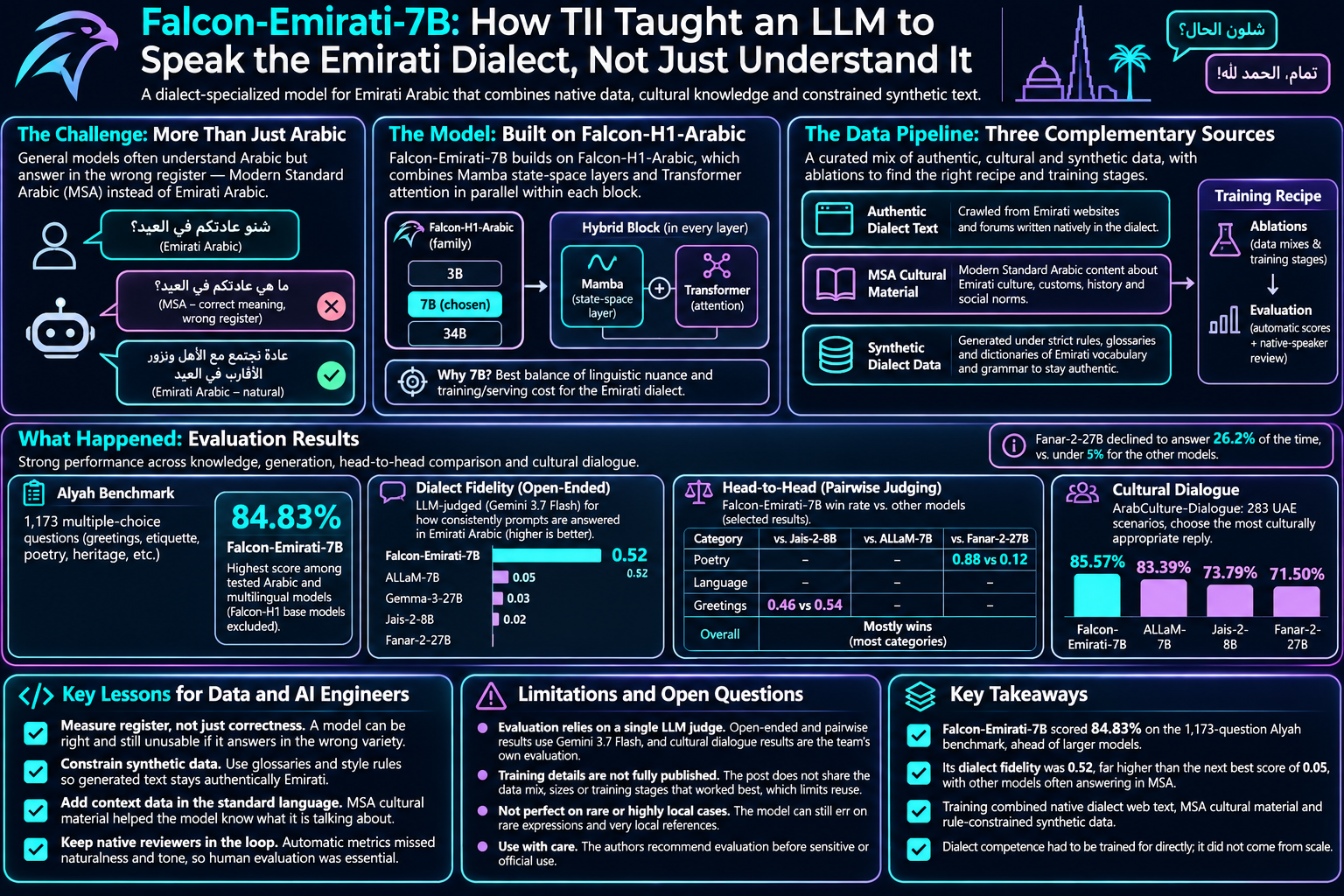
Arabic is often treated as a single language in discussions about multilingual artificial intelligence, but that classification hides a substantial amount of linguistic and cultural variation. Modern Standard Arabic (MSA) is the formal variety commonly encountered in written news and other standardised communication. Everyday conversations, humour, storytelling and social interactions in the UAE, however, frequently take place in Emirati Arabic, a Gulf dialect with its own vocabulary, expressions and cultural context [1].
For an AI model, recognising Arabic words is not the same as understanding how people actually communicate in a particular Arabic-speaking community. A model trained primarily on MSA may understand the individual words in an Emirati sentence, identify its broad subject and even produce a factually correct response. Yet it may fail to recognise an idiomatic expression, miss a cultural reference or respond in a formal register that feels unnatural in an everyday conversation.
This creates a gap between linguistic comprehension and conversational competence. A model can technically support Arabic while remaining poorly adapted to the way a particular community speaks.
The Technology Innovation Institute’s Falcon-Emirati-7B is designed to address this problem. Built on the Falcon-H1-Arabic model family, it focuses on understanding Emirati language and culture while also generating responses in the dialect itself. Its evaluation provides a useful case study in adapting an existing language model to a comparatively low-resource dialect, particularly through deliberate data construction, training-stage experimentation and evaluation beyond conventional factual correctness [1:1].
The central finding is significant: teaching a model to understand a dialect does not automatically teach it to communicate naturally in that dialect. Both capabilities need to be addressed.
Why it matters
A language model’s usefulness is not determined exclusively by whether it can produce the correct answer. The way it communicates that answer also matters, particularly when the application serves a specific linguistic community.
Consider a conversational assistant designed for users in the UAE. A user asks about a local custom, a cultural practice or an expression commonly used in everyday conversation. The model may understand the question and retrieve the relevant information, but respond in formal Modern Standard Arabic.
The answer might be factually correct, grammatically sound and understandable. Nevertheless, it may not resemble the language the user expected to hear.
This distinction becomes especially important in applications involving conversation, storytelling, cultural education and locally relevant digital services. Users are not necessarily looking for an assistant that simply translates their dialect into a formal language, processes the request and translates the answer back. They may expect the system to understand the cultural context and respond naturally within the same linguistic variety.
General-purpose multilingual models can therefore have a register problem. They may recognise dialectal input but default to a more standardised form when generating output.
The TII evaluation highlights this distinction. Falcon-Emirati-7B was compared with Arabic-focused and multilingual models, including models with considerably larger parameter counts. The results suggest that model scale alone did not produce reliable Emirati dialect competence. Some of the larger multilingual models performed substantially below smaller Arabic-focused alternatives [1:2].
This has implications beyond Emirati Arabic.
Many language communities communicate through regional dialects, local varieties and informal expressions that are not represented as extensively in written training material as standardised languages. A model may have considerable knowledge of a language while lacking the ability to participate naturally in the everyday communication patterns of its speakers.
The engineering challenge is therefore not simply to increase the quantity of language data. It is to identify which linguistic capabilities are missing and design training data that addresses them.
Falcon-Emirati-7B demonstrates an approach based on three complementary sources: authentic dialect text, standard-language material containing cultural knowledge and carefully constrained synthetic dialect data.
It also highlights an important evaluation principle. A model should be assessed not only on whether its answers are correct but also on whether it responds in the intended dialect, preserves the appropriate tone and demonstrates cultural understanding.
For products serving specific communities, correctness without linguistic authenticity can leave a substantial gap between technical capability and practical usefulness.
How it was built
Falcon-Emirati-7B was not developed as an entirely separate foundation model. It builds on Falcon-H1-Arabic, an Arabic-focused model family, and adds a dedicated adaptation process for Emirati language and cultural knowledge [1:3].
The development process combines architectural selection, specialised data collection, synthetic data generation and experiments to determine how different data sources should contribute during training.
The base.
Falcon-Emirati-7B builds on Falcon-H1-Arabic, whose architecture combines Mamba state-space layers and Transformer attention in parallel inside every block.
This hybrid design is an important part of the underlying model family. Rather than relying exclusively on Transformer attention, Falcon-H1 combines two different architectural approaches within its processing blocks.
The family is available in three parameter sizes: 3B, 7B and 34B. TII selected the 7B variant for Falcon-Emirati because it offered the preferred balance between linguistic nuance and the costs associated with training and serving the model [1:4].
That decision reflects a practical consideration in specialised model development.
A larger model may offer greater capacity, but parameter count alone does not establish that it will perform better on a narrowly defined linguistic task. The development team needed a configuration capable of learning the vocabulary, expressions and cultural context of Emirati Arabic without making training and deployment unnecessarily expensive.
The 7B model therefore represents a compromise between capability and operational considerations.
This is particularly relevant when adapting a foundation model to a specific dialect. The objective is not necessarily to build the largest possible model. It is to create a model whose capabilities are appropriately aligned with the target use case.
Falcon-H1-Arabic provides the underlying Arabic language capability, while the specialised training process focuses on the linguistic and cultural characteristics that distinguish Emirati Arabic.
Why it was hard.
Developing a model for Emirati Arabic introduces several challenges that are different from those encountered when training on a widely represented standard language.
The first is data availability. Emirati Arabic is predominantly spoken, which means there is relatively little written material available online compared with standardised Arabic content [1:5].
This creates a problem for language-model training. Models learn patterns from examples, including vocabulary, sentence structures, expressions and the ways people communicate in different contexts. When a dialect is underrepresented in written data, the model has fewer direct examples from which to learn its characteristic patterns.
A model trained primarily on MSA may consequently develop a strong understanding of formal Arabic without acquiring equivalent competence in Emirati expressions.
The second challenge is non-literal meaning.
Everyday communication frequently relies on expressions whose meaning cannot be understood simply by translating individual words. Humour, familiar expressions and culturally specific references require the model to interpret the intended meaning rather than process the sentence as a collection of literal translations.
This makes dialect adaptation more complicated than adding a vocabulary list. The model needs to learn how words and expressions are used in context.
The third challenge concerns the training recipe itself. There was no established approach specifying exactly how much dialect data should be included or at which stage of training it should be introduced [1:6].
This is a significant engineering question.
Adding dialect data is not automatically sufficient. The composition of the training dataset and the stage at which different material is introduced can influence what the model learns and how it generates responses.
A dataset containing too little authentic dialect material may not provide enough examples to establish reliable dialect patterns. Synthetic material that is insufficiently controlled may also introduce expressions that sound broadly Gulf Arabic without being authentically Emirati.
The team therefore approached the task experimentally, testing different data combinations and training stages rather than assuming that a single data mixture would work.
Three data sources [1:7]:
The training pipeline combined three complementary categories of material. Each addressed a different aspect of the adaptation problem.
1. Authentic dialect web text
The first source consisted of Emirati websites and forums written natively in the dialect.
This material provides examples of how Emirati Arabic appears in actual written communication. Unlike standard-language resources that may describe Emirati culture from an external or formal perspective, native dialect text gives the model direct exposure to the vocabulary and expressions used by speakers.
Authentic material is particularly valuable because dialect competence involves more than recognising individual words. The model needs examples of how expressions appear together and how people naturally communicate in the target variety.
Websites and forums also provide a source of language usage that differs from the formal register typically associated with MSA.
For a model whose objective is to answer users in Emirati Arabic, this distinction is important. Training on standardised Arabic alone may encourage the model to interpret dialectal questions while continuing to generate formal responses.
The inclusion of native dialect text helps address that imbalance by providing direct examples of the intended output variety.
2. MSA material about Emirati culture
The second source consisted of Modern Standard Arabic material covering Emirati culture, customs, history and social norms.
At first, including MSA material in a dialect-specialisation pipeline might seem counterintuitive. If the objective is to produce Emirati Arabic, why not use only dialectal text?
The answer lies in the difference between linguistic expression and subject knowledge.
Authentic dialect text helps the model learn how Emirati Arabic is used. However, the model also needs sufficient information about the subjects it will discuss.
A system can imitate the vocabulary and sentence patterns of a dialect without necessarily understanding the cultural context behind a particular question.
For example, an assistant might generate a response that sounds conversational but contains an inaccurate interpretation of a local custom. Linguistic authenticity alone would not make that answer useful.
The MSA cultural material addresses this knowledge requirement. It provides information about Emirati customs, history and social norms, helping the model understand what it is discussing [1:8].
This creates a complementary relationship between the first two data sources.
Native dialect text contributes language patterns and conversational expression, while MSA material contributes structured cultural knowledge. The model is trained to draw on both rather than treating dialect generation and subject understanding as the same capability.
This is an important distinction for specialised language models. A model may need to learn from multiple language varieties even when its intended output is focused on one particular dialect.
3. Synthetic dialect data
The third source consisted of synthetic Emirati dialect data generated under strict constraints.
Synthetic data can expand the amount of material available for training, which is particularly useful when authentic written examples are limited. However, generating dialectal text introduces its own risks.
A general-purpose model asked to produce Emirati Arabic may generate text that sounds broadly Gulf Arabic without consistently reflecting the target dialect. It may also drift towards MSA or use expressions that do not fit the intended linguistic variety.
For a specialised dialect model, this is a significant problem. Additional training examples are useful only if they reinforce the patterns the model is supposed to learn.
TII addressed this by generating synthetic material under strict rules, using glossaries and dictionaries covering Emirati vocabulary and grammar [1:9].
These constraints help keep the generated examples aligned with the intended dialect rather than allowing the synthetic dataset to become a collection of loosely related Arabic expressions.
The use of vocabulary and grammar references also makes the generation process more controlled. Instead of relying entirely on a general model’s interpretation of what Emirati Arabic should sound like, the pipeline provides explicit linguistic guidance.
This is particularly important when synthetic data supplements authentic material. If generated examples introduce inconsistent expressions, they can weaken the linguistic signal that the authentic data is intended to provide.
The three-source strategy therefore addresses different limitations:
- Authentic dialect text provides examples of native usage.
- MSA cultural material supplies knowledge about Emirati subjects and social context.
- Constrained synthetic data expands dialect training material while applying explicit linguistic rules.
The training recipe
Collecting the three data sources was only part of the process. The team also needed to determine how they should be combined and when different types of data should be introduced during training.
TII used ablation experiments to examine different data mixtures and training stages. The resulting configurations were judged using both automatic scores and native-speaker review [1:10].
Ablation studies are useful here because they allow researchers to examine the contribution of different parts of a training setup rather than treating the entire recipe as one indivisible process.
For example, the team could investigate whether including cultural material alongside dialect text improved the model’s performance, or whether different combinations of authentic and synthetic examples produced better results.
The training-stage experiments addressed another question: whether the point at which a particular data source is introduced influences the model’s ability to learn the intended capabilities.
This matters because the objective is not simply to expose the model to more Arabic. It is to adapt its existing capabilities towards a specific dialect while retaining the knowledge needed to answer questions about that community.
The evaluation process also combined two different forms of assessment.
Automatic scores provide a measurable way to compare model outputs across experiments. Native-speaker review adds an important human perspective, particularly for aspects of language quality that are difficult to capture through automated measurements.
A response can be understandable and grammatically plausible without sounding natural to someone who speaks the dialect. Native reviewers can assess that distinction more directly.
The team used both approaches to guide its training decisions, making the development process an exercise in balancing measurable task performance with actual dialect quality [1:11].
What happened
TII evaluated Falcon-Emirati-7B using several complementary tests. These included the Alyah benchmark, open-ended question answering, blind pairwise comparisons and culturally appropriate dialogue scenarios.
Together, the evaluations examine more than one aspect of the model’s performance. They measure whether it can answer questions about Emirati culture, whether it can generate responses in the dialect, how it compares with other Arabic and multilingual models, and whether its responses reflect appropriate cultural understanding.
Alyah benchmark.
The Alyah benchmark contains 1,173 native multiple-choice questions covering topics ranging from greetings and etiquette to poetry and heritage [1:12].
This provides a way to assess the model’s knowledge of Emirati language and culture through a consistent question set.
Falcon-Emirati-7B achieved 84.83%, outperforming every other Arabic and multilingual model included in the comparison. The Falcon-H1-Arabic base models were excluded from this comparison [1:13].
The result suggests that the specialised adaptation produced a model capable of answering questions about Emirati subjects more effectively than the evaluated alternatives.
The benchmark’s subject coverage is important when interpreting the result. It does not focus exclusively on conventional factual questions. Greetings, etiquette, poetry and heritage require familiarity with different aspects of the community’s linguistic and cultural context.
A model that performs well across these areas needs more than a general ability to understand Arabic sentences. It must also have relevant knowledge of the topics represented in the benchmark.
However, multiple-choice performance primarily establishes whether a model can select the appropriate answer from the available options. It does not, by itself, establish whether the model can naturally communicate that answer in Emirati Arabic.
That distinction is why TII also evaluated open-ended generation.
Answering in the dialect.
In the open-ended evaluation, models answered the same questions, and their responses were judged by Gemini 3.7 Flash [1:14].
Falcon-Emirati-7B led on correctness, but the more distinctive finding concerned dialect fidelity.
Its dialect-fidelity score was 0.52, compared with:
| Model | Dialect fidelity | |—|—:| | Falcon-Emirati-7B | 0.52 | | ALLaM-7B | 0.05 | | Gemma-3-27B | 0.03 | | Jais-2-8B | 0.02 | | Fanar-2-27B | Approximately 0.00 |
The gap is substantial. Falcon-Emirati-7B was the only one of the five tested models that reliably answered in Emirati Arabic rather than defaulting to Modern Standard Arabic [1:15].
The other models often knew the answer but generated it in MSA. This is precisely the distinction the specialised training pipeline was designed to address.
A model can correctly identify the meaning of an Emirati question without reproducing the linguistic variety in which the question was asked. If it responds in formal Arabic, it demonstrates comprehension but not necessarily dialect-level conversational competence.
The dialect-fidelity results therefore provide a different perspective from the Alyah accuracy score.
The 84.83% benchmark result indicates strong performance on the multiple-choice questions. The 0.52 dialect-fidelity score provides evidence that the model is also better adapted to generating responses in the target dialect.
The evaluation additionally revealed a difference in response behaviour. Fanar-2-27B declined to answer 26.2% of the time, compared with under 5% for the other models [1:16].
This is relevant when assessing practical conversational performance. A model’s usefulness depends not only on the quality of the answers it generates but also on whether it responds consistently when presented with questions it should be able to address.
Taken together, the open-ended results show why correctness and linguistic fidelity should be treated as separate evaluation dimensions.
Head-to-head.
TII also conducted blind pairwise judging, comparing Falcon-Emirati-7B against Jais-2-8B, ALLaM-7B and Fanar-2-27B [1:17].
Pairwise evaluation offers a different way to compare generated responses. Rather than relying only on an independent score for each answer, the evaluator considers competing responses and determines which one performs better.
In the reported tests, Falcon-Emirati-7B won most categories against the three competing models.
The widest margins appeared in poetry and language, where the specialised model demonstrated a particularly strong advantage.
One example was its comparison against Fanar-2-27B on poetry, where Falcon-Emirati-7B achieved a result of 0.88 against 0.12 [1:18].
Poetry is an interesting evaluation category because performance involves more than identifying factual information. Language choice, expression and the ability to work within the intended linguistic variety all contribute to the quality of the response.
The result is consistent with the broader evaluation finding that dialect adaptation needs to be measured through generated language rather than only through question-answering accuracy.
There was, however, one category in which Falcon-Emirati-7B narrowly lost: greetings.
Against Jais-2-8B, it scored 0.46 compared with 0.54 [1:19].
The team notes that greetings are the category in which Emirati Arabic and MSA overlap most. This provides an interesting contrast with the stronger results in poetry and language.
When the distinction between dialect and standard Arabic is less pronounced, the advantage of a specialised model may become smaller. The result also illustrates that dialect adaptation does not necessarily produce the best outcome in every category.
Cultural dialogue.
The final evaluation examined culturally appropriate responses using 283 UAE scenarios from the ArabCulture-Dialogue benchmark.
The task involved choosing the most culturally appropriate reply in each scenario [1:20].
Falcon-Emirati-7B achieved 85.57%, outperforming all three comparison models:
| Model | Score | |—|—:| | Falcon-Emirati-7B | 85.57% | | ALLaM-7B | 83.39% | | Jais-2-8B | 73.79% | | Fanar-2-27B | 71.50% |
The result indicates that the model’s adaptation extends beyond dialect vocabulary and response generation. It also performs well when the evaluation focuses on the cultural appropriateness of a reply.
This is an important dimension for conversational systems intended to serve a specific community.
A response can be linguistically understandable without being the most appropriate response in a particular cultural situation. The ability to select a culturally suitable reply requires the model to use contextual knowledge alongside its language capabilities.
The MSA cultural material included in the training pipeline is relevant here. It provides information about customs, history and social norms, while the authentic dialect and constrained synthetic data support the model’s ability to communicate in the intended variety.
The 85.57% result suggests that combining linguistic adaptation with cultural knowledge can produce benefits beyond simple dialect recognition.
It also reinforces the need to evaluate specialised models through multiple tasks. The Alyah benchmark, open-ended generation, pairwise comparisons and cultural dialogue each examine different aspects of the model’s capabilities.
What data and AI engineers should do
Falcon-Emirati-7B provides several useful lessons for engineers adapting language models to regional dialects, specialised domains or communities that are underrepresented in conventional training datasets.
The most important is to define the intended capability precisely. If the objective is to build a model that communicates naturally in a particular dialect, evaluating only whether it understands questions written in that dialect is insufficient.
Measure register, not just correctness.
A model can produce the right answer and still be unsuitable for the intended application if it responds in the wrong linguistic variety.
The difference between understanding an Emirati Arabic question and answering it in Emirati Arabic should be reflected in the evaluation framework.
For engineers, this means separating factual correctness from dialect fidelity. A benchmark that measures only whether the answer is correct may overlook a model’s tendency to default to MSA.
Open-ended evaluation can reveal this problem more clearly because the model has to generate its own response rather than select from predefined options.
The Falcon-Emirati-7B results demonstrate why this distinction matters: the competing models often knew the answer but responded in MSA, while the specialised model achieved substantially higher dialect fidelity [1:21].
Constrain synthetic data.
Synthetic data can help address limited availability of authentic dialect text, but its quality depends on how it is generated.
Unconstrained generation risks producing text that resembles a broad linguistic category without consistently matching the target dialect.
TII used glossaries, dictionaries and explicit rules covering Emirati vocabulary and grammar to constrain the generation process [1:22].
This offers a useful approach for other low-resource language and domain adaptations. Synthetic examples should reinforce the intended patterns rather than introduce loosely related material that increases dataset size without improving specialisation.
The objective should be to improve the quality and relevance of the training examples, not simply maximise their volume.
Add context data in the standard language.
A specialised dialect model may still benefit from knowledge material written in a standardised language.
TII included MSA content covering Emirati culture, customs, history and social norms alongside native dialect text [1:23].
This addresses a distinction between knowing how to communicate and knowing what to communicate.
Engineers adapting models to other regional languages or domains should consider whether their datasets contain enough subject knowledge, rather than focusing exclusively on the target language variety.
A model may need standard-language material to understand a subject while relying on dialect-specific examples to communicate naturally about it.
Keep native reviewers in the loop.
Automatic metrics provide useful comparisons, but they cannot necessarily capture every aspect of natural language use.
TII combined automatic evaluation with native-speaker review during its experiments [1:24].
This is especially relevant when assessing idiomatic expressions, humour, tone and cultural references. A response may appear acceptable to a general-purpose evaluator while sounding unnatural to someone familiar with the dialect.
Native reviewers can help identify those differences and provide a qualitative assessment that complements benchmark scores.
For engineering teams, human evaluation should be treated as part of the model-development process, not simply as a final approval step.
Limitations and open questions
Despite the strong reported results, Falcon-Emirati-7B’s evaluation has limitations that should be considered before treating it as a general-purpose solution for Emirati Arabic applications.
The first concern is the reliance on a single LLM judge for open-ended and pairwise evaluation. The generated responses were evaluated using Gemini 3.7 Flash, which introduces dependence on the judgement of another language model [1:25].
This is a practical way to compare a large number of responses, but an LLM-based evaluator is not equivalent to an independent human assessment. Judging whether a response is correct, natural and genuinely dialectal involves distinctions that may not always be captured consistently by an automated evaluator.
The development process did include native-speaker review for evaluating training experiments, which is valuable. However, the reported open-ended and pairwise results still rely on a single LLM judge.
The cultural benchmark results also come from the team’s own evaluation [1:26]. They are useful evidence of the model’s performance on the selected scenarios, but should not automatically be interpreted as proof of equivalent performance across every cultural context or real-world conversational situation.
Another limitation concerns reproducibility.
The post does not publish the data mixtures, dataset sizes or training stages that produced the best results [1:27].
These details would be particularly useful to researchers and engineering teams attempting to reproduce the approach for another dialect.
The overall strategy is clear: combine authentic dialect text, cultural knowledge and constrained synthetic data, then experiment with training-stage configurations. However, without the detailed data composition and the best-performing training recipe, it is difficult to determine exactly how much each component contributed to the final result.
This limits how directly other teams can reuse the methodology.
The model also has limitations in its linguistic coverage. The authors acknowledge that it can still make mistakes involving rare expressions and highly local references, and recommend evaluation before sensitive or official use [1:28].
This is an important qualification. Dialect competence is not a binary capability that can be established through a single benchmark score. Regional expressions and local references can vary, and a model that performs well across a general evaluation dataset may still struggle with less common forms of communication.
For applications where language accuracy has significant consequences, teams should conduct their own evaluations using representative material from the intended user community.
There is also a distinction between performing well on curated benchmarks and maintaining consistent behaviour in open-ended conversations. The reported results provide evidence across several evaluation categories, but they do not eliminate the need to test how the model handles unfamiliar expressions and different conversational contexts.
For engineers, the broader lesson is that specialised model adaptation requires continuous evaluation. A strong benchmark result is a starting point for assessing capability, not a guarantee that every real-world interaction will be handled correctly.
Falcon-Emirati-7B demonstrates the potential of deliberate dialect adaptation, while its limitations highlight the importance of transparent training details, diverse evaluation methods and native-speaker assessment.
Key takeaways
- Falcon-Emirati-7B scored 84.83% on the 1,173-question Alyah benchmark, outperforming the other evaluated Arabic and multilingual models, including larger alternatives. [1:29]
- Its open-ended dialect-fidelity score was 0.52, compared with 0.05 for the next-best competitor, ALLaM-7B. Other models often answered correctly but defaulted to Modern Standard Arabic. [1:30]
- The training pipeline combined authentic Emirati dialect web text, MSA cultural material and synthetic dialect data generated under explicit vocabulary and grammar constraints. [1:31]
- Falcon-Emirati-7B also scored 85.57% on 283 UAE cultural dialogue scenarios, ahead of ALLaM-7B, Jais-2-8B and Fanar-2-27B. [1:32]
- Dialect competence requires deliberate adaptation. Model scale alone did not produce reliable Emirati Arabic generation, making data composition, training-stage experimentation and native-speaker evaluation essential parts of the process. [1:33]

Discussion
Join the discussion: create a free account or sign in to comment.
No comments yet.