
NVIDIA cuOpt mPDLP: Solving 100-Million-Variable Linear Programs Across Multiple GPUs
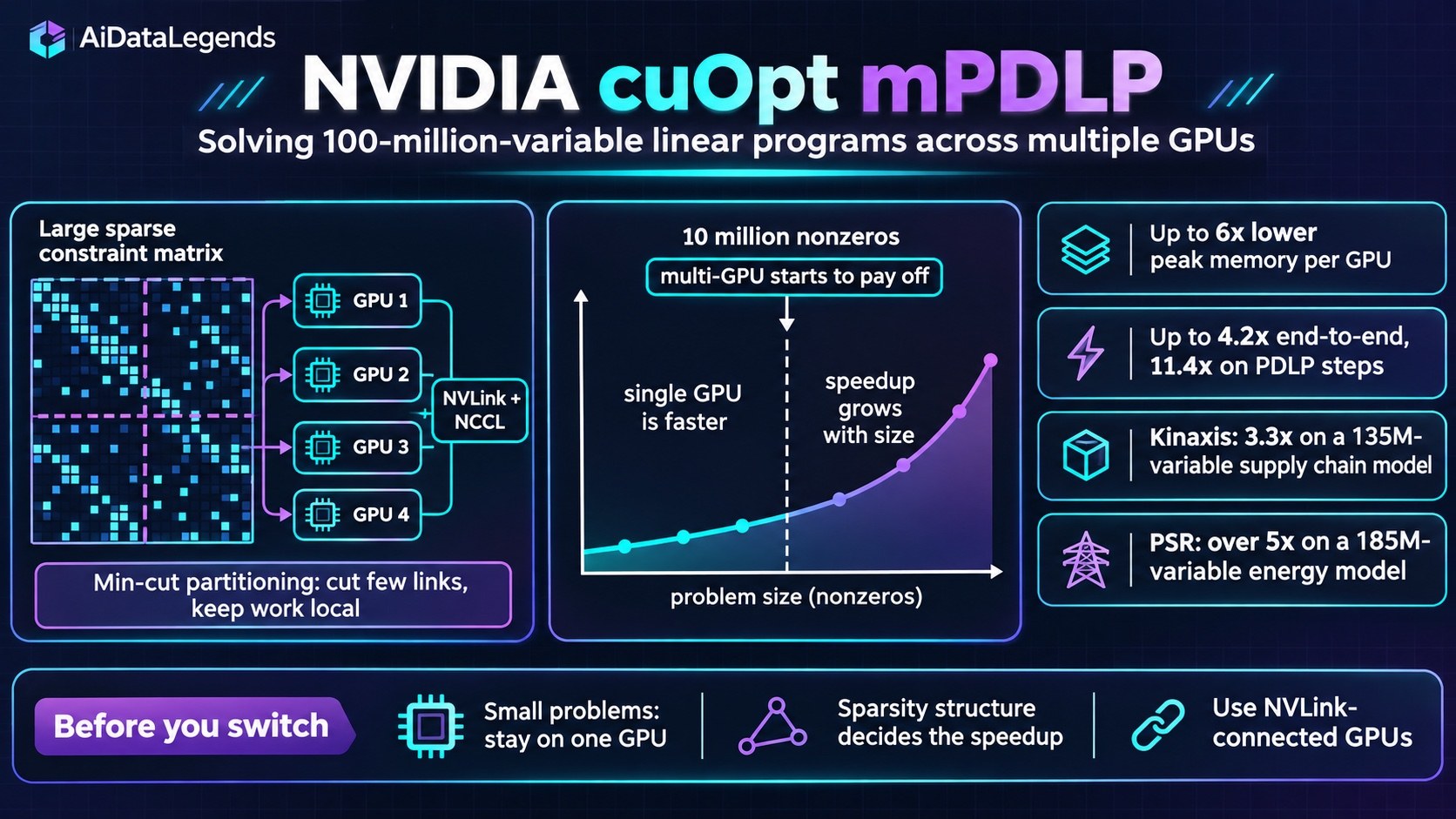
cuOpt's new multi-GPU PDLP solver splits huge LP problems across NVLink-connected GPUs using min-cut partitioning, cutting per-GPU memory by up to 6x. Gains appear above 10 million nonzeros.

Supply chains span more SKUs, lanes and constraints than ever, while energy grids must balance increasingly distributed sources of generation and demand. Behind these planning decisions are large linear programming (LP) models: mathematical representations of objectives, variables and constraints that help organizations determine how to allocate resources under competing requirements.
As these models grow, solving them becomes an infrastructure challenge as much as an optimization challenge. A model may take hours to solve, miss the planning window in which its results would be useful, or simply exceed the memory capacity of a single GPU. NVIDIA’s cuOpt now addresses this limitation with mPDLP, a multi-GPU version of its Primal-Dual Hybrid Gradient (PDLP) solver that distributes a single LP across NVLink-connected GPUs [1].
The scale is significant. NVIDIA reports that mPDLP can handle problems with up to 2.1 billion nonzeros, while reducing peak memory consumption per GPU by as much as 6x compared with single-GPU PDLP [1:1]. On zib03, a benchmark with more than 104 million nonzeros that has been studied since 2008, NVIDIA reports a solve rate nearly 10 times faster than it achieved a year earlier [1:2].
The important change is not simply that cuOpt can use more GPUs. It is how the solver divides the optimization problem. Instead of distributing matrix blocks without fully accounting for the relationships between variables and constraints, mPDLP models the LP as a bipartite graph and uses min-cut partitioning to reduce communication between GPUs. This is particularly relevant because the core PDLP iteration repeatedly operates on a sparse constraint matrix and its transpose.
For organizations running large-scale planning workloads, the ability to distribute one optimization problem across several GPUs can change which models are practical to solve within an operational planning window.
Why it matters
Large-scale optimization is increasingly important in systems where decisions involve many interacting resources and constraints.
A supply chain model, for example, may need to represent products, facilities, transportation lanes and planning constraints. An energy expansion model may represent generation capacity and the decisions required to satisfy future demand. As the number of variables and constraints grows, the resulting LP becomes more computationally demanding.
The operational constraint is often time. A model that finishes after several hours may still produce a mathematically valid answer, but that answer may arrive too late to inform the next planning cycle. If a model cannot complete overnight, it may not be useful for decisions that need to be made the following morning.
Memory creates another barrier. Sparse optimization problems can contain enormous numbers of nonzero matrix entries even when most possible matrix positions are empty. The solver must still store and process the relevant matrix structure, along with the associated vectors and intermediate data. At sufficiently large scales, a single GPU may not have enough memory to accommodate the problem efficiently.
mPDLP addresses both constraints by distributing a single LP across multiple GPUs. Rather than requiring the entire problem to fit on one device, it assigns portions of the optimization workload to GPUs connected through high-bandwidth NVLink infrastructure.
NVIDIA reports up to 6x lower peak memory per GPU than single-GPU PDLP for problems reaching 2.1 billion nonzeros [1:3]. This is important because the benefit is not limited to reducing execution time. Distributing the matrix and its associated work also makes larger problems possible within the memory capacity of a multi-GPU node.
The reported partner results illustrate the potential impact on practical optimization workloads:
- Kinaxis reported a 3.3x speedup on a supply chain model containing more than 135 million variables, using eight H100 GPUs.
- PSR reported a speedup of more than 5x on an energy expansion model with 185 million variables, using eight B200 GPUs [1:4].
These results are particularly relevant because they involve different optimization domains. The underlying technique is not restricted to one specific planning application. It targets the sparse linear algebra operations used by large LP models, which appear across a range of decision-optimization workloads.
There is, however, an important qualification. Multi-GPU execution introduces communication and synchronization costs. Adding GPUs does not automatically make every problem faster. The matrix must be divided in a way that allows each device to perform enough useful local work without spending too much time exchanging data with other devices.
That is the central problem mPDLP’s partitioning strategy attempts to solve.
How it works
PDLP in one paragraph
Primal-Dual Hybrid Gradient for linear programming is a first-order optimization method. Its general approach is similar in spirit to gradient descent: it repeatedly updates primal and dual variables using information derived from the optimization problem.
The method is attractive for large GPU workloads because its main computational operations map well to parallel hardware. Each iteration is dominated by two sparse matrix-vector multiplications (SpMVs): one involving the constraint matrix and another involving its transpose. These operations are accompanied by comparatively inexpensive element-wise updates [1:5] [2].
Understanding those two SpMVs is important because they explain both the computational structure of PDLP and the communication problem that appears when the solver moves to multiple GPUs.
An LP can be represented using a sparse constraint matrix. Its rows correspond to constraints, while its columns correspond to decision variables. The matrix describes how the variables participate in the constraints.
The forward matrix-vector multiplication uses the matrix to calculate values associated with the constraints. The multiplication involving the transpose moves information in the opposite direction, back across the relationship between constraints and variables.
Both operations must be performed repeatedly during optimization. Consequently, the cost of accessing matrix entries and moving the associated vector data has a direct effect on iteration performance.
PDLP is a first-order method, so it can be well suited to GPU acceleration, but the number of iterations required to reach the desired convergence tolerance can still be large. Making each iteration efficient is therefore important, particularly for problems with hundreds of millions or billions of nonzero entries.
Why more GPUs help
Sparse matrix-vector multiplication is generally memory-bound. The operation performs relatively little arithmetic for each matrix entry it processes, so the ability to retrieve data efficiently is often more important than raw arithmetic throughput.
A multi-GPU system provides access to the combined memory bandwidth of several devices. If the matrix and associated data can be distributed effectively, each GPU can process part of the workload in parallel.
In principle, this creates an opportunity to reduce the time spent on the two dominant SpMVs. It also distributes the memory requirements across the participating devices, allowing a problem to exceed the capacity of an individual GPU.
But distribution introduces a second workload: communication.
The GPUs need access to vector values associated with the matrix entries they process. When an operation requires data owned by another GPU, that information must be exchanged. If the partitioning creates too many cross-GPU dependencies, communication can consume the time saved through parallel execution.
Load imbalance creates another problem. A partition with substantially more nonzero entries than others may take longer to process, leaving the remaining GPUs waiting for it to finish. A multi-GPU solver needs to manage both the amount of local work and the communication required between devices.
The design challenge is therefore not just to divide the matrix into pieces. It is to divide it in a way that preserves useful locality across repeated operations.
Min-cut partitioning: treating the LP as a graph
An earlier approach, D-PDLP, divides the constraint matrix into two-dimensional blocks and computes each SpMV independently. This provides a way to distribute matrix operations, but it does not explicitly optimize the partition around the relationships between variables and constraints that are used repeatedly during PDLP iterations.
mPDLP takes a different approach. It represents the matrix as a bipartite graph, with one set of nodes corresponding to variables and another set corresponding to constraints. An edge connects a variable to a constraint when the corresponding matrix entry is nonzero.
This representation makes the communication structure visible.
A matrix entry is no longer just a value stored at a particular row and column position. It represents a relationship between a variable and a constraint. When those two endpoints are assigned to different GPUs, processing that relationship can require communication. When they are assigned to the same GPU, the associated work can remain local.
mPDLP uses min-cut partitioning to divide this graph while attempting to cut as few edges as possible [1:6].
Each GPU owns a set of rows and columns, corresponding to its assigned constraints and variables. Edges whose endpoints belong to the same partition can be processed locally. Edges crossing partition boundaries represent dependencies that may require data exchange between GPUs.
The objective is to keep as much of the matrix’s computational work local as possible while limiting the number of relationships that cross GPU boundaries.
This is especially important because PDLP repeatedly performs two operations involving the constraint matrix and its transpose. The data dependencies of those operations are related. A partition that preserves locality across the graph can therefore reduce communication pressure in both directions.
In other words, the partitioning strategy is designed around the repeated structure of the algorithm rather than treating each matrix multiplication as an unrelated operation.
The resulting data exchanges use NVLink, NVSwitch and NCCL [1:7]. These technologies provide the communication infrastructure required for GPUs within the node to exchange the information needed by the distributed solver.
The distinction between matrix partitioning and graph partitioning is important. Dividing a matrix into blocks can distribute storage and computation, but it does not necessarily minimize the relationships that cross device boundaries. Modeling the LP as a bipartite graph gives the partitioner a way to reason about those relationships directly.
For large sparse problems, reducing the number of cut edges can be a major factor in whether multi-GPU execution delivers a meaningful improvement.
Communication is part of the algorithm
In a distributed optimization system, communication is not an incidental cost that can be ignored after the computation has been divided. It is part of the execution model.
Every iteration needs the results of the two dominant SpMVs and the associated updates. If the matrix partition creates a large number of dependencies between GPUs, the solver must exchange more information before it can complete those operations.
That creates a trade-off.
A partition that minimizes communication may not distribute computational work evenly. Conversely, a partition that balances the number of matrix entries across GPUs may create many cross-partition edges. Either situation can reduce the effectiveness of multi-GPU execution.
mPDLP’s min-cut approach prioritizes keeping graph relationships within partitions. NVIDIA’s reported results suggest that this strategy works well for many of the large instances in its evaluation, although the remaining limitations show that communication minimization alone does not resolve every partitioning problem.
The solver uses NVLink and NVSwitch for the GPU interconnect and NCCL for communication [1:8]. These components are important because the design assumes that participating GPUs can exchange data efficiently within a node. The implementation is not simply a generic distributed solver that can be expected to scale in the same way over any network.
This hardware assumption is central to understanding where mPDLP fits. It is designed for multi-GPU execution on systems with fast interconnects, where communication can be made efficient enough to preserve the benefits of parallel sparse computation.
What happened
NVIDIA benchmarked more than 100 LP instances using a tolerance of (10^{-6}) and a one-hour time limit on a DGX B200 node [1:9].
The evaluation compared mPDLP with both single-GPU cuOpt and the earlier D-PDLP approach. These comparisons answer different questions.
The single-GPU comparison shows when distributing the problem across multiple GPUs becomes worthwhile. The D-PDLP comparison examines whether the newer graph-partitioning strategy improves on an existing multi-GPU approach.
Against single-GPU cuOpt
The performance advantage of mPDLP becomes visible once problems exceed approximately 10 million nonzeros. Below that scale, the overhead of coordinating multiple GPUs can outweigh the benefit of parallel execution.
This is an important threshold for anyone evaluating the solver. A problem with fewer nonzeros may be better handled by a single GPU, even if multiple GPUs are available. The additional synchronization and communication required by distributed execution do not disappear simply because the hardware has more aggregate bandwidth.
As problem size increases, the opportunity for parallel execution becomes more substantial.
For the largest instance in NVIDIA’s comparison, mPDLP achieved a 4.2x end-to-end speedup over single-GPU cuOpt. If the comparison considers only the distributed PDLP steps, the speedup reaches 11.4x [1:10].
The distinction between those two figures is important.
The complete solution process includes more than the repeated PDLP iterations. Presolve, matrix transposition, partitioning and postsolve are not distributed in the same way as the core PDLP computation. Those stages remain part of the end-to-end runtime.
Consequently, the speedup of the distributed solver steps can be substantially higher than the speedup of the complete optimization workflow. The 11.4x result describes the core distributed PDLP steps, while 4.2x represents the larger end-to-end comparison for the largest instance.
This distinction is useful when evaluating optimization infrastructure. Accelerating the dominant computation is valuable, but the total improvement is constrained by the other stages that still contribute to execution time.
Against D-PDLP
The second comparison evaluates mPDLP against D-PDLP, the earlier multi-GPU approach.
For most instances above 10 million nonzeros, mPDLP was between 1.2x and 2.5x faster [1:11]. This supports the value of the graph-based partitioning strategy for many of the large problems in the benchmark.
However, mPDLP was slower on three ultra-large benchmark instances.
NVIDIA notes that these instances may not reflect the sparsity patterns of the real-world problems it tunes for. That is an important qualification because graph partitioning is sensitive to the structure of the matrix. A partitioning strategy that works well for one distribution of nonzero entries may not produce the same communication profile for another.
The result also demonstrates why multi-GPU performance should not be judged by problem size alone. Two LPs with similar numbers of nonzeros can have different graph structures and different communication requirements.
A solver that performs well on one may not necessarily achieve the same scaling on the other.
Results from industry partners
NVIDIA also reports performance improvements from partners using mPDLP on practical optimization workloads.
<text weight=“semibold”>Kinaxis: supply chain optimization</text>
Kinaxis reported a 3.3x speedup on a supply chain model with more than 135 million variables, using eight H100 GPUs [1:12].
This result is relevant to planning systems where the optimization model represents a large collection of decisions and constraints. A shorter solve time can make it more practical to run optimization more frequently or work with larger models within an existing planning window.
<text weight=“semibold”>PSR: energy expansion planning</text>
PSR reported a speedup of more than 5x on an energy expansion model containing 185 million variables, using eight B200 GPUs [1:13].
Energy expansion planning is another example of a domain in which large optimization models can support decisions involving substantial interconnected systems. The reported improvement indicates that the multi-GPU approach can benefit workloads beyond supply chain planning.
These partner results should be interpreted as workload-specific outcomes, not universal performance guarantees. They use different models and GPU configurations, and their speedups should not be treated as directly comparable measurements of the same benchmark.
Nevertheless, they demonstrate that the approach is being evaluated against real planning problems rather than only synthetic matrix workloads.
What data and AI engineers should do
mPDLP is relevant to engineers responsible for optimization infrastructure, GPU workloads and large-scale decision systems. The results also offer practical guidance for teams deciding whether to move an existing LP solver from one GPU to multiple GPUs.
-
Check problem size before distributing the workload. NVIDIA’s results show that gains begin to appear above approximately 10 million nonzeros. Below that range, the synchronization and communication overhead can outweigh the benefits of parallel execution. A single GPU may remain the more efficient choice for smaller instances.
-
Inspect sparsity and graph structure, not just variable count. The number of variables and nonzeros provides an indication of scale, but it does not fully describe how well a problem will partition. The number of relationships crossing partition boundaries affects communication. Problems with many cut edges may lose much of the expected speedup [1:14].
-
Use NVLink-connected GPUs. The design depends on fast communication between GPUs within a node. NVLink and NVSwitch provide the interconnect, while NCCL handles exchanges. Teams should not assume that the same scaling will be achieved on systems without comparable GPU-to-GPU communication capabilities.
-
Benchmark the complete solve process. The 11.4x result for distributed PDLP steps is not the same as the 4.2x end-to-end speedup. Presolve, matrix transposition, partitioning and postsolve remain relevant to total runtime. Infrastructure decisions should use complete solve times alongside kernel or iteration-level measurements.
-
Compare partitioning strategies on representative models. mPDLP outperformed D-PDLP on most tested instances above 10 million nonzeros, but it was slower on three ultra-large benchmarks. This makes representative workload testing essential. A benchmark with a different sparsity pattern may produce a different outcome.
-
Start with NVIDIA’s tutorial. The cuOpt mPDLP tutorial covers installation, configuration and comparison of solve times across different GPU counts. The solver is also open source on GitHub [1:15] [3]. These resources provide a practical starting point for evaluating the implementation rather than relying only on reported benchmark results.
-
Consider the planning window as a performance metric. The value of a faster solver is not limited to reducing GPU execution time. If an optimization can finish within an operational window that it previously missed, it may become useful for a different class of decisions. Teams should evaluate whether the improvement enables more frequent planning, larger models or faster iteration.
-
Account for convergence requirements. PDLP is a first-order method, and large problems may still require millions of iterations to converge. Faster execution per iteration does not automatically eliminate the work required to reach the requested tolerance. Both iteration performance and convergence behavior matter when assessing the solver.
The central lesson is to treat multi-GPU optimization as a combination of computational scaling, memory distribution and communication management. Adding devices is only the first step. The matrix structure and the way data moves between devices determine whether those additional GPUs translate into a useful reduction in solve time.
Limitations and open questions
The reported speedups are encouraging, but mPDLP’s performance depends heavily on the structure of the optimization problem.
The most visible limitation is partition quality. Min-cut partitioning attempts to reduce the number of edges crossing GPU boundaries, but a low edge count does not necessarily guarantee balanced computational work. Two partitions can have different numbers of nonzero entries or different processing requirements even when the graph cut is relatively small.
NVIDIA acknowledges that the current partitioning approach does not yet account for per-GPU compute load [1:16]. That leaves room for improvements that consider both communication and the amount of work assigned to each device.
The roadmap includes weight-aware and hypergraph partitioning. These approaches are intended to improve how the workload is divided by taking additional characteristics of the problem into account. NVIDIA also identifies overlapping communication with computation as an area of ongoing work [1:17].
That overlap is particularly relevant to distributed sparse computation. If communication can take place while GPUs are processing independent local work, some of the communication cost may be hidden behind computation. The effectiveness of that strategy will depend on the structure of the workload and the available execution opportunities.
Another area under development is feasibility polishing. The goal is to obtain feasible answers faster, potentially at some cost to optimality [1:18]. This reflects an important distinction in operational optimization: some applications may benefit from receiving a useful feasible solution earlier, even if further work is needed to improve it.
However, feasibility and optimality are not interchangeable. A feasible solution satisfies the problem’s constraints, while an optimal solution also achieves the best objective value under those constraints. Any trade-off between obtaining a feasible answer quickly and reaching optimality must be evaluated against the requirements of the application.
The underlying optimization method also imposes a limit. PDLP is a first-order method, and very large problems may still need millions of iterations to converge. Improving the speed of each iteration is valuable, but it does not guarantee that the number of iterations will be small.
The benchmark results also show that multi-GPU execution is not uniformly faster. mPDLP was slower than D-PDLP on three ultra-large instances. NVIDIA suggests that their sparsity patterns may differ from those of the real-world workloads targeted by the implementation. This is a reminder that the characteristics of a benchmark set influence the conclusions that can be drawn from it.
Finally, the end-to-end results include stages that are not distributed. Presolve, transposition, partitioning and postsolve remain part of the workflow. As the distributed PDLP computation becomes faster, these other stages may account for a larger share of total solve time. That makes further optimization of the complete pipeline an important area to watch.
The next phase of multi-GPU optimization will therefore involve more than increasing the number of GPUs. Better partitioning, workload balancing, communication overlap and earlier feasible solutions could all influence how effectively large LPs can be solved.
Key takeaways
- NVIDIA cuOpt mPDLP distributes a single linear programming problem across NVLink-connected GPUs, reducing peak memory consumption per GPU by up to 6x for problems reaching 2.1 billion nonzeros. [1:19]
- The solver uses a bipartite graph representation of variables and constraints, with min-cut partitioning to keep more computation local and reduce cross-GPU communication. [1:20]
- The dominant PDLP operations are two sparse matrix-vector multiplications per iteration, making memory bandwidth and data locality central to multi-GPU performance. [1:21] [2:1]
- Performance gains begin to appear above approximately 10 million nonzeros. For the largest tested instance, mPDLP achieved a 4.2x end-to-end speedup and an 11.4x speedup when measuring only the distributed PDLP steps. [1:22]
- Against D-PDLP, mPDLP was 1.2x to 2.5x faster on most tested instances above 10 million nonzeros, but it was slower on three ultra-large benchmarks. [1:23]
- Industry partners reported a 3.3x speedup for a supply chain model with more than 135 million variables on eight H100 GPUs and a speedup greater than 5x for an energy expansion model with 185 million variables on eight B200 GPUs. [1:24]
- The current approach still has limitations around per-GPU compute balance, partition quality and convergence. Weight-aware and hypergraph partitioning, communication-computation overlap and feasibility polishing are identified as ongoing work. [1:25]
The larger significance of mPDLP is that it treats the distribution of an optimization problem as a graph-structure problem rather than merely a matrix-splitting exercise. That distinction matters because the two dominant operations in PDLP repeatedly move information between variables and constraints. Keeping those relationships local can reduce the communication burden that often limits multi-GPU scaling.
For data and AI infrastructure teams, this is a useful development to watch. Large optimization workloads are increasingly part of operational decision systems, and their usefulness depends on both model scale and the time required to produce an answer. mPDLP does not eliminate the trade-offs involved in distributed optimization, but it provides a practical path for solving much larger LPs across multiple GPUs while addressing memory pressure and communication locality.
Sources
NVIDIA Technical Blog, “Scaling Decision Optimization to 100 Million Variables and Beyond with mPDLP in NVIDIA cuOpt”, 2026-10-07. https://developer.nvidia.com/blog/scaling-decision-optimization-to-100-million-variables-and-beyond-with-mpdlp-in-nvidia-cuopt/ ↩︎ ↩︎ ↩︎ ↩︎ ↩︎ ↩︎ ↩︎ ↩︎ ↩︎ ↩︎ ↩︎ ↩︎ ↩︎ ↩︎ ↩︎ ↩︎ ↩︎ ↩︎ ↩︎ ↩︎ ↩︎ ↩︎ ↩︎ ↩︎ ↩︎ ↩︎
arXiv, “Practical Large-Scale Linear Programming using Primal-Dual Hybrid Gradient”, 2021-06-09. https://arxiv.org/abs/2106.04756 ↩︎ ↩︎
GitHub, “NVIDIA/cuopt: GPU accelerated decision optimization”. https://github.com/NVIDIA/cuopt ↩︎

Discussion
Join the discussion: create a free account or sign in to comment.
No comments yet.