
dbt State Is GA: Stop Rebuilding Models That Did Not Change
dbt State compares each model's compiled SQL and upstream freshness with the last good build, then reuses, clones or rebuilds it. Early customers report 9% to 59% lower costs.

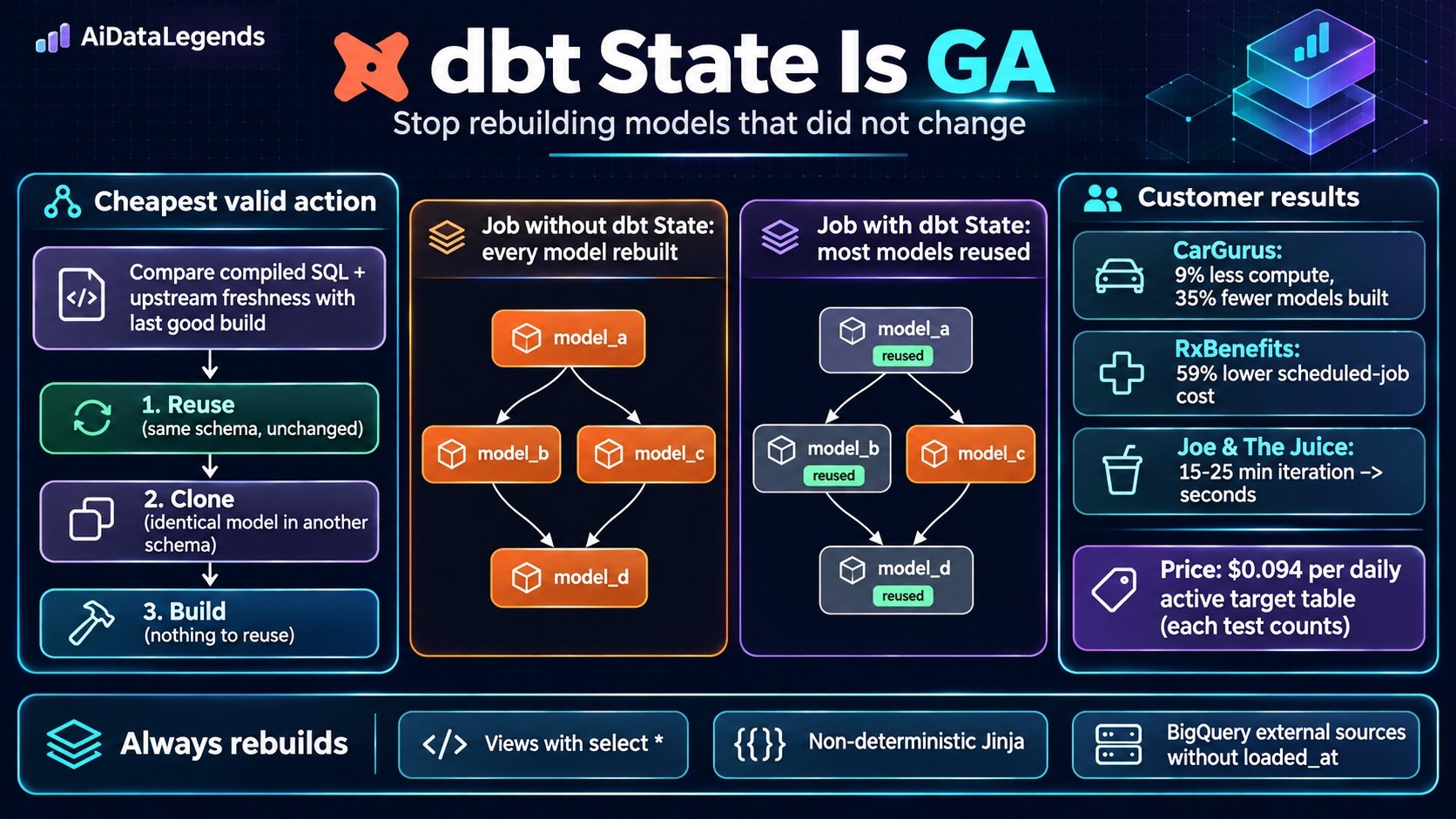
More than 22 million dbt models are built every day, and a substantial proportion of those builds happen even when nothing upstream has changed [1]. For data and analytics engineering teams, this represents a familiar problem: warehouse compute is consumed repeatedly to produce results that already exist and remain valid.
Consider a data platform running several scheduled pipelines. One pipeline builds customer dimensions, another produces financial reporting models, and a third prepares datasets for downstream analytics. Even when these pipelines share models, each job may execute its own build operations. If the underlying SQL and source data have not changed, much of that computation may be unnecessary.
The challenge is not simply identifying which files have changed in a repository. A model can remain unchanged while its upstream data changes, making a rebuild necessary. Conversely, a pipeline can run again without any change to either the model’s logic or the data it depends on.
This is where dbt State comes in.
Now generally available, dbt State introduces model-level reuse based on two important conditions: whether the model’s compiled SQL has changed and whether its upstream data is sufficiently fresh relative to the previous successful build [1:1].
Instead of treating every pipeline execution as an instruction to rebuild its models, dbt State evaluates each model independently and chooses the least expensive valid action. It can reuse an existing object, clone a matching object from another schema or perform a fresh build when necessary.
The important architectural distinction is that this decision happens at the model level rather than the job level. Consequently, multiple pipelines that depend on the same model can benefit from an already valid result.
For organisations running large dbt projects, this changes the economics of data refresh. Repeated executions no longer have to translate directly into repeated warehouse computation. Early customers have reported compute and scheduled-job cost reductions ranging from 9% to 59%, alongside improvements in development and iteration times [1:2].
Why it matters
For analytics engineers, warehouse expenditure is not driven only by the size of the data platform or the complexity of individual models. It is also influenced by how frequently existing transformations are executed.
A dbt project can contain hundreds or thousands of models, each representing a transformation in the data pipeline. These models depend on upstream sources and other models, creating a dependency structure that determines how data moves through the project.
When a pipeline runs, models need to be built in an order that respects those dependencies. If an upstream model changes, downstream models may need to be rebuilt to reflect the updated data.
However, not every pipeline execution introduces a meaningful change.
Imagine a model that calculates customer-level metrics from an existing customer dataset. Its SQL remains identical, the upstream data has not changed and the previous build completed successfully.
Running the same transformation again does not necessarily produce a new analytical result. Yet without a reuse mechanism, the warehouse may still execute the model and perform the associated computation.
At the scale of a large analytics platform, these repeated operations can become a significant source of unnecessary expenditure.
The problem becomes more pronounced when multiple jobs use the same models.
A development workflow might build a model during testing. A scheduled production pipeline may subsequently build the same model, even though the development execution has already produced an equivalent result. Other jobs may repeat the process independently.
The underlying issue is that traditional pipeline execution is often organised around jobs, while the actual reusable unit is the model.
dbt State changes that perspective.
Instead of asking whether a particular job needs to execute all its models, the system evaluates whether each model needs a new build. If the previous result is still valid, it can be reused rather than recomputed.
This introduces a more efficient relationship between pipeline frequency and warehouse consumption.
One of the practical consequences is that teams can schedule refreshes more frequently without necessarily increasing compute expenditure at the same rate.
For example, Obie moved key pipelines from daily execution to every two hours after adopting dbt State [1:3].
This is an important operational benefit. More frequent pipeline execution can improve the availability of refreshed analytical data, but traditionally it also increases the number of transformations executed. If unchanged models can be reused, teams gain more flexibility in deciding how frequently their workflows should run.
The value is therefore not limited to reducing warehouse costs. It also changes how data teams can approach freshness requirements.
A team may previously have avoided more frequent refreshes because the additional computation was difficult to justify. Model-level reuse provides another option: execute the pipeline more frequently while rebuilding only the models whose logic or upstream data actually requires it.
This is particularly relevant to organisations with shared models, multiple scheduled jobs and large transformation graphs.
The central idea is straightforward: a pipeline run should not automatically mean that every model in that pipeline must be rebuilt.
What happened
dbt Labs demonstrated the difference using two hourly jobs operating over the same models.
One job ran without dbt State, while the other used the new reuse functionality [1:4].
In the conventional execution, every model and its associated tests ran during the job. The pipeline repeated its work even when the underlying models had not changed.
With dbt State enabled, nearly every model was marked as reused. Tests did not rerun for reused models because those tests had already passed [1:5].
This illustrates how the feature changes the execution behaviour of an existing dbt workflow.
Rather than interpreting every scheduled execution as a requirement to recompute the full model set, dbt State checks whether the previous result can still be considered valid.
The comparison also demonstrates that reuse is not limited to consecutive executions of the same job.
A third job using the same model can reuse the last valid result produced by another job, provided its upstream sources have not changed [1:6].
This cross-job behaviour is particularly important in shared analytics environments.
Consider a model that is used by a development workflow, a CI process and a production pipeline. Without model-level reuse, each workflow may independently trigger a transformation, even if an equivalent result has already been produced.
With dbt State, the previous valid build can be reused across those jobs.
The system is therefore not merely optimising one pipeline’s execution. It is making reusable model results available across different workflows that depend on the same underlying transformation.
This changes the way teams can think about shared data assets. A model does not necessarily need to be rebuilt just because another job has requested it. Its previous successful result may already satisfy the requirements of the new execution.
The distinction between job-level execution and model-level validity is the foundation of the feature.
How it works
dbt State evaluates each model against its last successful build, comparing the compiled SQL and the freshness of its upstream data. Based on those conditions, it chooses one of three actions: reuse, clone or build [1:7].
This is important because checking only whether the SQL has changed would be insufficient.
A model’s transformation logic may remain identical while the data feeding it changes. In that situation, the previous output may no longer represent the latest required state.
Similarly, upstream data may remain unchanged while the model’s SQL is modified. Reusing the previous result in that case would ignore the updated transformation logic.
The reuse decision therefore needs to account for both code and data freshness.
1. Reuse
The first option is to reuse an existing object in the target schema.
This is possible when three conditions are satisfied:
- The object already exists in the target schema.
- The model’s logic has not changed.
- Its upstream data has not changed beyond the configured lag tolerance [1:8].
When these conditions hold, dbt State can avoid rebuilding the model.
The previous result is considered sufficiently valid for the current execution, so the system does not need to repeat the transformation.
This is the most direct form of optimisation because the existing object is already available in the destination environment.
Consider an hourly pipeline that includes a customer dimension model. The model’s compiled SQL is unchanged, and none of its upstream sources has changed within the configured freshness window.
Without reuse, the pipeline would execute the transformation again. With dbt State, the model can be marked as reused.
The benefit becomes more significant when a project contains many such models. Instead of repeatedly executing every transformation, the pipeline can concentrate its computation on the models that genuinely require it.
The feature also applies to tests. In the demonstrated comparison, tests associated with reused models did not rerun because they had already passed [1:9].
This avoids repeating validation work when the underlying model result remains unchanged and its previous tests have already succeeded.
2. Clone
The second option is to clone a matching object from another schema.
This is useful when the target schema does not already contain the required reusable object, but an equivalent object exists elsewhere.
For example, a matching model may already have been built in a development or CI environment. If its logic is identical and its data is sufficiently fresh, dbt State can clone that result into another schema instead of rebuilding the model [1:10].
This extends reuse beyond the schema in which the previous build originally occurred.
The distinction between reuse and cloning is important.
Reuse applies when the required object already exists in the target schema. Cloning allows the system to take advantage of an equivalent object available in another schema.
Both approaches avoid unnecessary transformation execution, but they address different conditions in the model’s execution environment.
The cross-schema capability is particularly useful for teams with multiple environments and workflows.
A model may have been built during a development or CI run, and another workflow may subsequently need the same result. If the model’s logic and upstream freshness satisfy the reuse requirements, the previous build can be used instead of repeating the computation.
This creates an opportunity to reduce duplicated work across development, testing and production-related workflows.
3. Build
The third option is to perform a fresh build.
If the existing object cannot be reused and no suitable matching object is available for cloning, dbt State builds the model normally [1:11].
This is essential because the objective is not to avoid computation at all costs. It is to avoid computation only when the previous result remains valid.
A model whose compiled SQL has changed needs a new result reflecting the updated transformation.
Likewise, a model whose upstream data has changed beyond the permitted freshness threshold may need to be rebuilt to incorporate the new information.
The build option ensures that dbt State does not compromise data correctness in pursuit of lower warehouse consumption.
The three actions therefore form a decision process:
| Condition | Action | |—|—| | Matching object exists in target schema, logic is unchanged and upstream data is sufficiently fresh | Reuse | | Suitable matching object exists in another schema, with identical logic and fresh data | Clone | | Neither reuse nor cloning is valid | Build |
The important point is that dbt State evaluates these conditions independently for each model.
A pipeline can therefore contain a mixture of reused, cloned and newly built models during the same execution.
Per-model configuration
The reuse mechanism also provides per-model settings that allow teams to tune how freshness and code comparisons are handled [1:12].
This matters because not every model has the same freshness requirements.
A model used for operational reporting may need to reflect relatively recent source changes, while another model used for less frequently updated reporting may not require an immediate rebuild after every upstream update.
Applying one global freshness policy to every model can therefore be unnecessarily restrictive.
dbt State provides configuration options that allow teams to express these differences.
lag_tolerance
The lag_tolerance setting controls how long after the last upstream data change a model can continue to use its previous result before a rebuild is required.
This gives teams a way to balance data freshness against computation.
For a model that requires frequent updates, a tighter tolerance can ensure that upstream changes trigger rebuilding relatively quickly.
For a model that only needs weekly freshness, a longer tolerance may be appropriate.
Consider a reporting model whose consumers only require weekly updates. Rebuilding it every time an upstream source changes may generate unnecessary warehouse activity.
Raising its lag_tolerance allows the team to avoid rebuilding immediately after every source update, provided the configured freshness requirements are still satisfied.
The important consideration is that this setting represents an explicit freshness trade-off. A longer tolerance can reduce computation, but it also means the model may continue using a previous result for longer.
Engineers should therefore configure it according to the actual requirements of the downstream consumers rather than increasing it indiscriminately.
require_fresh_data_from
The require_fresh_data_from setting controls when upstream source updates should trigger a rebuild.
The configuration can require a rebuild when any source updates or only once all sources have updated [1:13].
This is relevant for models that depend on multiple upstream sources.
Imagine a model that combines information from two sources. If one source updates before the other, rebuilding immediately may produce a result based on a mixture of different source freshness states.
Depending on the model’s requirements, the team may prefer to wait until all relevant sources have updated before rebuilding.
Alternatively, some models may need to respond to any individual source update as soon as it occurs.
The setting allows engineers to express that difference instead of applying one uniform trigger policy across every model.
compare_unrendered_code
The compare_unrendered_code setting controls whether a model’s unrendered code is compared with the code from its previous build when making the reuse decision [1:14].
This adds another dimension to determining whether a model should be considered unchanged.
The distinction is between the model’s code before rendering and the compiled SQL used for execution.
Because dbt models are evaluated through compiled SQL, comparing the compiled representation provides an important basis for determining whether the transformation logic has changed.
The additional setting allows teams to control whether the unrendered code should also participate in the comparison.
The appropriate configuration depends on how the project uses its model definitions and how teams want changes to be evaluated.
Together, these three settings allow engineers to tune reuse behaviour at the model level rather than forcing every transformation to follow identical freshness and comparison rules.
Explaining reuse decisions
One particularly useful addition is dbt state explain.
The command shows which nodes were built, skipped, cloned or deferred during a run and explains why those decisions were made [1:15].
This is important because an optimisation mechanism needs to be observable.
If a model is unexpectedly rebuilt, engineers need to understand which condition prevented reuse. Similarly, if a model is reused, they should be able to inspect the decision rather than treating it as an unexplained behaviour.
Without visibility into these decisions, debugging a pipeline could become more complicated. A team might see that a model did not execute but have no immediate explanation of whether it was reused, cloned or excluded for another reason.
dbt state explain provides a way to inspect the execution decisions and understand what happened to individual nodes.
It also makes the feature useful for CI workflows, where teams need visibility into how changes affect the build graph.
For organisations introducing dbt State into existing projects, this kind of observability is particularly important during the initial tuning period.
Migration from earlier state-aware orchestration
Teams moving from the earlier state-aware orchestration feature need to pay attention to configuration changes.
In particular, AWS-style or legacy assumptions should not be carried over without mapping the previous build_after configuration to the new settings [1:16].
Without an appropriate mapping, the new defaults apply:
- A 45-minute lag tolerance.
- Rebuild when any source updates.
These defaults can produce different execution behaviour from an existing configuration [1:17].
Consequently, migration should involve reviewing the freshness requirements of individual models and translating the previous settings into the new configuration approach.
The important lesson is that enabling model reuse is not simply a matter of switching on a feature and assuming that every model will behave exactly as it did under the earlier orchestration setup.
The underlying freshness and source-update policies need to be understood and configured deliberately.
What it saves, and costs
The commercial case for dbt State is supported by several customer examples published by dbt Labs. The reported results cover warehouse compute, model execution counts, scheduled-job costs and development iteration time [1:18].
The customer experiences differ, but they illustrate how model-level reuse can affect both production pipelines and development workflows.
CarGurus: lower compute and fewer builds
CarGurus reported a 9% reduction in compute and 35% fewer models built after adopting dbt State.
The company also reduced Snowflake backfill costs by 15% [1:19].
These results highlight two different benefits.
The reduction in compute indicates that avoiding unnecessary transformations can translate into lower warehouse consumption.
The reduction in the number of models built shows how much execution activity can be eliminated when the system recognises that existing results remain valid.
The backfill savings are also interesting because backfills can involve substantial repeated computation. Reuse provides an opportunity to avoid rebuilding models that do not require new results during those workflows.
RxBenefits: scheduled-job cost reduction
RxBenefits reported a 59% reduction in scheduled-job costs on a Snowflake adaptive warehouse [1:20].
The company reused more than 700,000 models and saved two weeks of query time over a 60-day period.
This is one of the strongest reported examples of the potential impact.
The number of reused models illustrates why the optimisation becomes more valuable in larger environments. Even relatively small amounts of unnecessary computation can accumulate when repeated across a large transformation graph and many scheduled executions.
The saved query time also provides another way to understand the benefit. Avoiding repeated work is not only about reducing expenditure; it can reduce the amount of warehouse execution required to maintain the same analytical outputs.
Fanatics Betting and Gaming: improved reuse in a pilot
Fanatics Betting and Gaming reported that model reuse increased from 0.2% to approximately 15% in its pilot, reaching as high as 25% in some projects [1:21].
This example is particularly useful because it demonstrates how much reuse behaviour can change after introducing the feature.
A very low starting reuse rate suggests that the existing execution patterns were rebuilding models frequently rather than taking advantage of previously generated results.
The increase to approximately 15%, and up to 25% in some projects, indicates that model-level evaluation can identify opportunities that were not being captured by the previous workflow.
The results also show that reuse levels can vary across projects. Different model structures, source freshness requirements and execution patterns will influence how often an existing result can be used.
Joe & The Juice: faster development iteration
Joe & The Juice reported a particularly striking improvement in development speed.
Iteration on a 400-million-row fact table dropped from approximately 15 to 25 minutes to seconds [1:22].
This example extends the value proposition beyond scheduled production jobs.
Data engineers frequently need to iterate on transformation logic during development. They may make a change, test the result, inspect the output and then repeat the process.
When every iteration triggers expensive transformations over large datasets, development becomes slower.
If unchanged upstream models can be reused, the engineer can avoid repeating work that is unrelated to the current change.
The reported reduction from minutes to seconds demonstrates how model reuse can improve the feedback loop during development, particularly when working with large fact tables.
Pricing
dbt State is priced at $0.094 per daily active target table. Each test counts as its own target [1:23].
This pricing detail is important because the number of billable targets is not necessarily equal to the number of models in a project.
Consider a model with two tests: not_null and unique.
The model itself counts as one target, and each of its two tests counts as an additional target.
That produces three daily active targets:
[ 3 \times \$0.094 = \$0.282 ]
Therefore, a model with those two tests costs $0.282 per day when reused, regardless of how many runs reuse it [1:24].
This is a useful distinction when evaluating the economics of the feature.
The savings from avoiding repeated warehouse execution need to be compared with the daily active target charges. Teams with extensive testing may have more billable targets than they initially expect.
For smaller models with relatively inexpensive transformations, the additional feature cost may narrow the financial benefit.
For larger transformations or frequently executed models, the avoided computation may provide a more substantial advantage.
dbt Cost Insights provides visibility into what teams pay and save through the feature [1:25].
Platform availability
dbt State is generally available for Snowflake, BigQuery and Databricks, with Redshift support in preview [1:26].
This is relevant for organisations operating across different warehouse platforms because availability determines where the feature can be introduced immediately and where teams may need to wait for broader support.
The combination of pricing visibility and warehouse-specific availability should be considered when planning adoption across multiple projects.
Ultimately, the financial calculation should compare the cost of daily active targets against the warehouse computation avoided through reuse, cloning and reduced test execution.
The customer results published by dbt Labs provide encouraging examples, but the actual benefit will depend on each project’s execution frequency, model structure, testing strategy and freshness requirements.
What data and AI engineers should do
dbt State introduces an opportunity to reduce redundant transformation work, but getting the most value from it requires deliberate configuration and visibility into model behaviour.
The following practices provide a sensible starting point.
Turn it on with defaults, then tune slow-moving models.
Starting with the default configuration gives teams an opportunity to observe how dbt State behaves across an existing project.
Once the initial execution patterns are visible, engineers can identify models that do not require frequent upstream freshness and consider increasing their lag_tolerance [1:27].
For example, a model used for weekly reporting may not need to rebuild immediately whenever an upstream source changes.
A longer tolerance can reduce unnecessary execution while keeping the model aligned with its intended freshness requirements.
However, this should be a model-specific decision. Operationally sensitive models may need much tighter freshness guarantees.
The objective is not to maximise the number of reused models. It is to reuse models where doing so remains consistent with the data freshness requirements of their consumers.
Fix the patterns that always rebuild.
dbt Labs identifies several patterns that can prevent models from benefiting from reuse [1:28].
The first involves views using select *.
In these cases, dbt cannot resolve the columns, which prevents the expected comparison behaviour. The recommended approach is to exclude views using the following configuration:
--exclude config.materialized:view
This is an important consideration for projects that contain many views. Rather than assuming every model is eligible for reuse, teams should identify patterns that prevent reliable evaluation.
The second issue involves non-deterministic Jinja.
For example, relation lookups that return results in a varying order can introduce inconsistent output during compilation or comparison.
Even when the underlying logical intent appears unchanged, non-deterministic behaviour can make it difficult for the system to establish that the model is equivalent to its previous version.
Engineers should review Jinja patterns that depend on ordering and ensure that the model’s rendered behaviour is stable.
The third issue concerns BigQuery external sources without a loaded_at_field or loaded_at_query.
These configurations affect the ability to establish upstream freshness. Without the appropriate information, dbt State may not have the required basis for deciding whether the previous result remains valid [1:29].
These patterns are worth reviewing before concluding that the feature is not providing sufficient reuse.
Use dbt state explain in CI.
The explanation command should be part of the team’s diagnostic workflow.
Using dbt state explain in CI makes reuse decisions visible and auditable [1:30].
When a model is rebuilt unexpectedly, engineers can investigate why the system considered the previous result unsuitable.
When a model is reused, the team can understand the conditions that allowed that decision.
This is particularly useful when configuration changes are introduced or when a project contains complex dependencies across multiple environments.
The command also helps teams identify opportunities to improve reuse rather than relying on assumptions about how the build graph behaves.
Count your tests when estimating cost.
A common mistake when estimating dbt State expenditure is to count only the models.
Each test is billed as an individual target, so heavily tested models can increase the number of daily active targets substantially [1:31].
For example, a model with not_null and unique tests represents three billable targets rather than one.
Before enabling the feature across a large project, teams should estimate the total number of models and tests that may become active targets.
They should then compare that cost with the expected reduction in warehouse computation.
This is especially important for smaller models, where the cost of repeated execution may already be relatively low.
Limitations and open questions
The customer results published by dbt Labs are encouraging, but they should be interpreted as vendor-reported examples rather than universal performance guarantees.
CarGurus, RxBenefits, Fanatics Betting and Gaming, and Joe & The Juice operate different projects and workloads. Their reported savings are based on different baselines, warehouse environments and execution patterns [1:32].
Consequently, the 9% to 59% reductions should not be treated as a guaranteed outcome for every dbt deployment.
A project with many large models that run frequently may have substantial opportunities for reuse. Another project with smaller transformations, frequently changing sources or strict freshness requirements may see a more limited benefit.
The second consideration is the relationship between testing and pricing.
Because every test counts as a target, projects with extensive test coverage may pay more than expected [1:33].
This is not necessarily a reason to reduce testing. Tests remain important for validating model quality, and removing useful checks simply to reduce the feature’s billable target count could introduce a different risk.
Instead, teams need to evaluate the actual cost of their model and test inventory against the computation they expect to avoid.
There are also questions about how reuse and cloning interact with warehouse observability.
The dbt Labs announcement does not discuss how cloned objects appear in warehouse lineage or how their costs are represented in cost attribution [1:34].
For data platform teams, lineage and cost attribution are important operational concerns. When an object is reused or cloned across schemas and jobs, engineers need to understand how those operations are represented in their existing monitoring and governance processes.
The announcement also does not explain how concurrent jobs coordinate when they reach the same model at the same time [1:35].
This is an interesting question for environments with multiple scheduled pipelines sharing the same model.
If two jobs independently request the same model, the way the system coordinates those requests can influence execution behaviour and the amount of computation avoided.
The published material does not provide enough detail to establish how these concurrent scenarios are handled.
Finally, reuse decisions still depend on correct configuration.
An overly permissive freshness policy may allow models to retain older results longer than consumers expect. An overly restrictive policy may trigger rebuilds that could otherwise have been avoided.
The value of dbt State therefore depends not only on enabling the feature but also on understanding the freshness requirements and execution characteristics of individual models.
The most effective adoption strategy is to begin with visibility, observe which models are reused or rebuilt, and then tune the configuration according to actual workload requirements.
Key takeaways
- dbt State evaluates every model independently, comparing compiled SQL and upstream data freshness against the last successful build to decide whether to reuse, clone or rebuild it. [1:36]
- Reuse works across jobs and environments, allowing development, CI and production workflows to benefit from previously generated valid model results. [1:37]
- Early customer results include 9% lower compute at CarGurus, 59% lower scheduled-job costs at RxBenefits and development iterations reduced from 15–25 minutes to seconds at Joe & The Juice. [1:38]
- Per-model settings such as
lag_tolerance,require_fresh_data_fromandcompare_unrendered_codeallow teams to balance freshness requirements against unnecessary computation. [1:39] - Pricing is $0.094 per daily active target table, with every test counted separately. A model with
not_nullanduniquetests costs $0.282 per day when reused. [1:40] - For data engineers, the biggest opportunity is to make reuse observable, eliminate patterns that prevent it and tune freshness policies according to actual downstream requirements. [1:41]


Discussion
Join the discussion: create a free account or sign in to comment.
No comments yet.