
Jev in SQL: Classify Text Columns in DuckDB and MotherDuck With Typed Answers
TypeSafe's Jev scores a fixed list of answers instead of writing text. MotherDuck classified 100,000 complaints in 82 seconds for $0.50, and DuckDB extensions turn plain-English conditions into WHERE clauses.

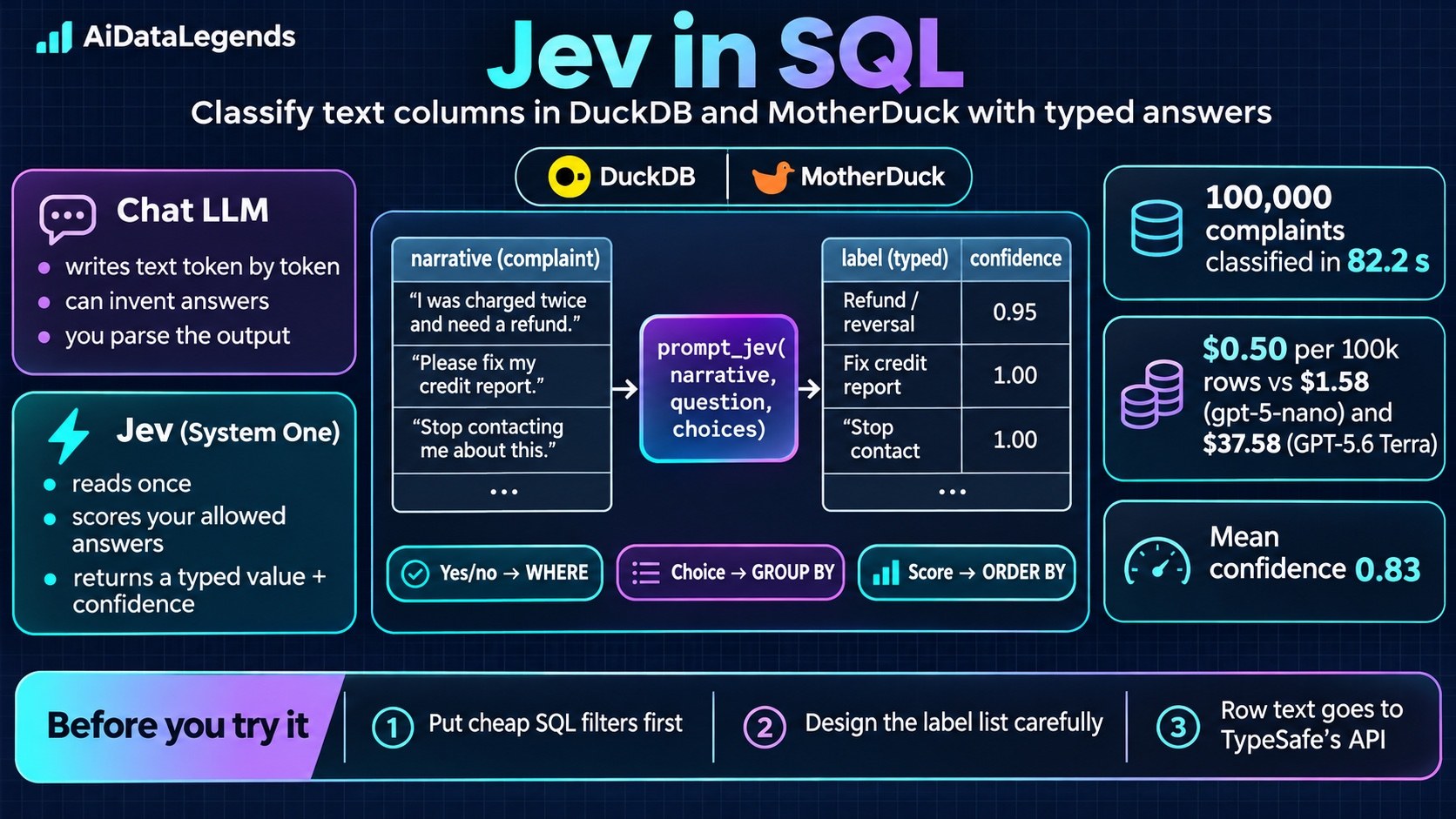
Most tables have a text column hiding a question nobody has answered: is this customer angry, what is this complaint asking for, which team should handle this ticket? The usual options are to label data and train a classifier, or to send every row to a chat LLM and parse what comes back. Jev, a model TypeSafe AI released on 15 September 2026, offers a third: it returns a typed answer and a probability instead of a paragraph [1]. Within days, DuckDB community extensions and a MotherDuck function put it inside plain SQL [1:1] [2].
Why it matters
Jev turns classification into a SQL function. You pass a row of text, a question and the allowed answers, and get back a boolean, a label or a score, plus a confidence value, that DuckDB can filter, group and sort like any other column [1:2] [2:1]. For analytics engineers that means no training pipeline, no embeddings and no parsing of LLM output, for questions you can answer from a fixed list.
What Jev is
TypeSafe calls Jev a “System One” model, after Kahneman’s fast, intuitive thinking. A chat LLM writes its answer token by token; Jev reads the text once and scores the answers you allowed [2:2]. It never generates a sentence, and it cannot invent an answer outside your list [1:3] [2:3]. There are three question shapes, each matching something SQL already has [1:4] [2:4]:
- Yes/no conditions that return a probability, for
WHERE. - Choice among labels, for
GROUP BY. - Score on an ordered scale, for
ORDER BY.
TypeSafe quotes 70 to 500 ms latency and $0.042 per million input tokens, with output tokens free, and questions in one request are evaluated in parallel [1:5].
What happened
MotherDuck’s benchmark. MotherDuck’s prompt_jev() classified 100,000 consumer complaints from the CFPB into seven requested-outcome categories in 82.2 seconds. On 10,000 of the same rows, gpt-5-nano through prompt() took 6 minutes 9 seconds, against 12.5 seconds for Jev, roughly 30 times faster. On cost, the launch benchmark put Jev at $0.50 per 100,000 rows, against $1.58 for gpt-5-nano and $37.58 for GPT-5.6 Terra: about 1% of the frontier model’s bill [2:5].
DuckDB extensions. The first SQL integration was pg-jev for Postgres, which turns a plain-English condition into a WHERE clause. DuckDB ports followed within days, built independently with different choices about batching and caching [1:6]. A jev extension is in the community repository for DuckDB 1.5.5 and 1.5.6; most others must be built and loaded as unsigned extensions [1:7].
How it works
DuckDB hands extensions rows in chunks of up to 2,048, which suits batched API calls. One extension groups each chunk by question, skips duplicate rows and sends batches across concurrent threads, retrying rate-limit and server errors [1:8]. Batching matters: another reports a 0.211-second median for 100 rows sent in batches of 25, against 16.8 seconds one row at a time, from a single local run [1:9].
Because jev() returns a boolean, it composes with ordinary SQL. Put a cheap condition such as age > 40 in the same WHERE clause and it runs first, so rejected rows are never sent to the API. A LIMIT stops the scan early, and a per-statement row cap limits spend [1:10].
In MotherDuck, the question and choices must be constants. To keep a taxonomy in a table, load it into a DuckDB variable and pass getvariable('request_labels'), which is resolved before the query runs [2:6].
How far to trust the labels
MotherDuck’s walkthrough is careful here [2:7]:
- Confidence. Across the 100,000 rows, mean confidence was 0.83; 65.8% of rows scored 0.8 or above and 10.9% fell below 0.5. Low-confidence rows are a natural review queue.
- Agreement. On 300 rows also labeled by GPT-5 and Claude Opus 5.5, the two LLMs agreed on 218. Jev matched them on 90.4% of those rows, and on 96.9% of the ones where its confidence was at least 0.8.
- Payoff. Once the label is a column, analysis is cheap: grouping all 100,000 complaints by request and refund outcome ran in 0.9 seconds.
What data and AI engineers should do
- Use it for repeated, bounded decisions: complaint intent, product family, “did they ask for a refund?”. Use an LLM to design the categories, as MotherDuck did with 40 sampled rows, then Jev to apply them [2:8].
- Design the label list carefully. Jev only returns your options, so poor options give you neatly typed poor answers [2:9].
- Put cheap filters first and cap rows per statement to control cost [1:11].
- Test batch size. pg-jev’s documentation reports accuracy dropping above roughly 20 to 25 rows per request [1:12].
- Check data handling. Every integration sends row text to TypeSafe’s API [1:13] [2:10].
Limitations and open questions
Jev is in early access behind a waitlist, the DuckDB extensions are days old and mostly unsigned, and most performance numbers come from their own authors [1:14]. MotherDuck’s 82-second run and its 40-second news-article benchmark are different tasks, and neither will transfer directly to your table [2:11]. For a fixed classification task at high volume, commenters note that a fine-tuned small model or embedding retrieval can still be cheaper once training is paid for [1:15]. Jev fits best when you have no labeled data and a new question to ask.
Key takeaways
- Jev scores a fixed list of answers and returns typed values with probabilities, so it slots into WHERE, GROUP BY and ORDER BY. [1:16] [2:12]
- MotherDuck classified 100,000 complaints in 82.2 seconds; per 100,000 rows, Jev cost $0.50 against $1.58 for gpt-5-nano and $37.58 for GPT-5.6 Terra. [2:13]
- Use confidence scores to route uncertain rows to review: 10.9% of rows fell below 0.5 in MotherDuck’s run. [2:14]
- The DuckDB extensions are new and send row text to a third-party API; start on a small, non-sensitive sample. [1:17]
Sources
DuckDB Blog, “Jev and DuckDB: Plain-English Conditions in SQL”, 2026-09-29. https://duckdb.org/2026/09/29/jev.html ↩︎ ↩︎ ↩︎ ↩︎ ↩︎ ↩︎ ↩︎ ↩︎ ↩︎ ↩︎ ↩︎ ↩︎ ↩︎ ↩︎ ↩︎ ↩︎ ↩︎ ↩︎
MotherDuck Blog, “Jev for analytics: turn text columns into gold, in plain SQL”, 2026-09-29. https://motherduck.com/blog/jev-for-analytics ↩︎ ↩︎ ↩︎ ↩︎ ↩︎ ↩︎ ↩︎ ↩︎ ↩︎ ↩︎ ↩︎ ↩︎ ↩︎ ↩︎ ↩︎

Discussion
Join the discussion: create a free account or sign in to comment.
No comments yet.