 AIDataLegends
OpenAI Dots: A Persistent Cloud Agent for 4,000+ Apps
Dots gives Pro and Business Premium users a dedicated cloud computer powered by GPT-6 Astra, but its high default cost makes the cheaper GPT-6.1 Sol a critical consideration for engineers.

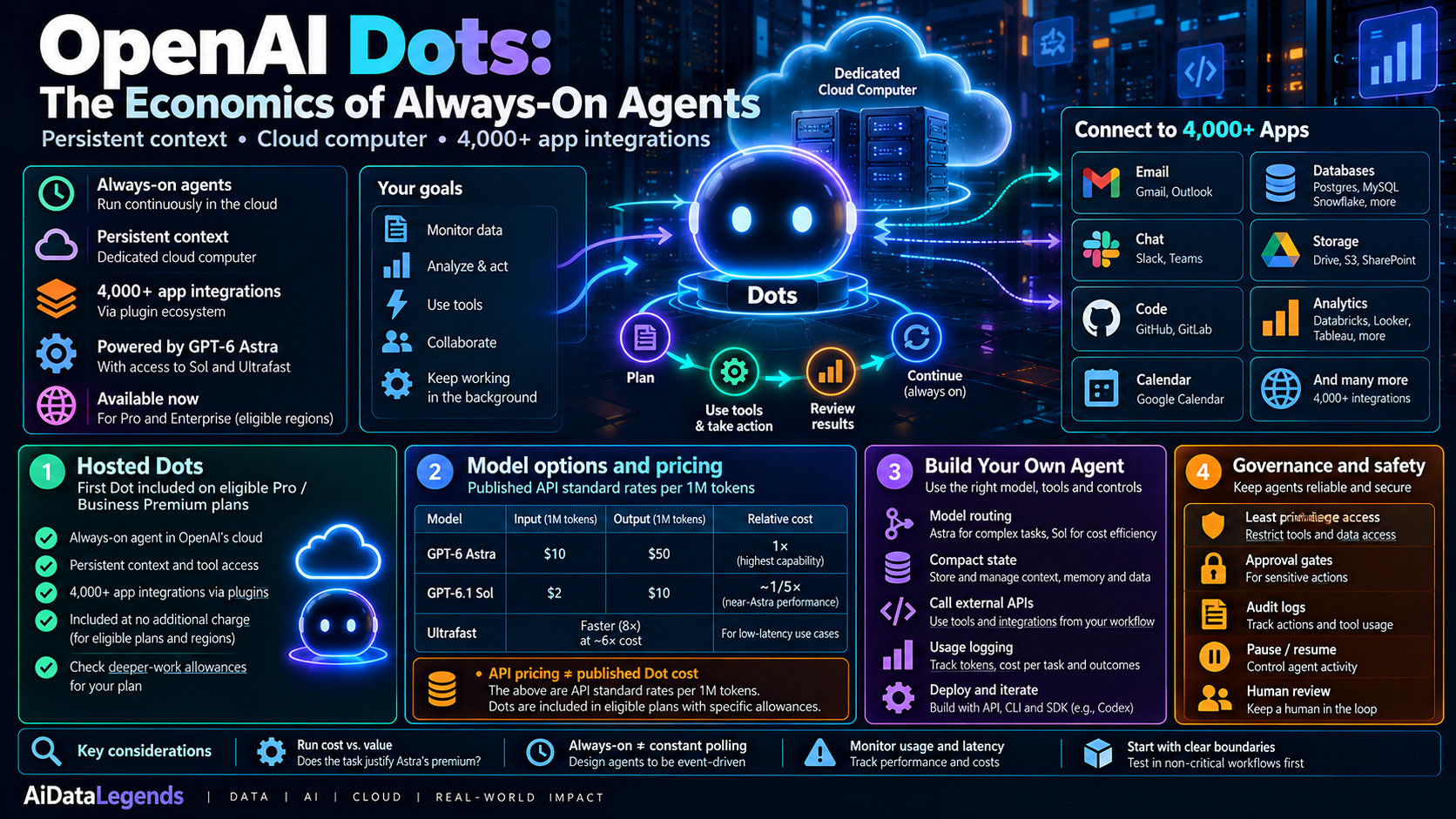
OpenAI says Dots are always-on agents running on GPT-6 Astra with a dedicated cloud computer, and that they reach over 4,000 apps through a plugin ecosystem [1]. For engineers, the interesting question is whether a persistent agent that idles and polls thousands of integrations around the clock remains economically viable at Astra’s price point, or whether a cheaper successor model shifts the unit economics enough to make always-on workloads practical.
Why it matters
For data and AI engineers, the most immediate consequence is how Dots reshape cost modeling inside a team.
OpenAI confirms that the initial dot is included at no additional charge for Pro and Business Premium subscribers in eligible regions [1:1]. For engineers assessing the cost of persistent agents on GPT-6 Astra against scheduled pipelines, this complimentary access offers a low-risk opportunity to test the system.
What happened
OpenAI held DevDay 2026 on September 29 at Fort Mason in San Francisco [2]. Simon Willison’s live blog also highlights GPT-6.1 Sol, which offers near-Astra performance at one-fifth the price [2:1], alongside an Ultrafast tier that runs eight times faster at six times the cost [2:2].
On availability, Willison notes Dots went live for Pro and Enterprise subscribers on launch day itself [2:3].
How it works
Under the hood, a Dots instance is a long-lived process hosted in OpenAI’s cloud rather than a local CLI session. For enterprises, Microsoft Agent 365 supplies the governance and security perimeter around those persistent sessions [1:2].
The economics are where the design decisions get interesting. Simon Willison reports that GPT-6.1 Sol delivers near-Astra intelligence at roughly one-fifth the per-token cost, which changes the unit economics of keeping a dot alive for hours [2:4]. A Pro 500 subscription bundles Ultrafast access with twenty-five times the usage allowance of a Plus plan, effectively pricing sustained agent workloads into a flat monthly fee [2:5]. The trade-off is straightforward: Astra-backed dots get the strongest reasoning and widest tool coverage, but at a premium that Sol largely erases for non-latency-critical tasks.
OpenAI’s real-time stack transmits audio and JSON control events over a single WebRTC channel, while an optional sideband WebSocket handles server-side integrations [3]. Client delegation allows connections to arbitrary backends, though this mode is fixed at session creation and cannot be changed during the conversation [3:1]. Partners including LiveKit, Twilio, Telnyx, and Daily/Pipecat supply the necessary telephony and media infrastructure for these server-side paths [3:2].
What data and AI engineers should do
In practice, before committing to a persistent cloud agent on GPT-6 Astra, benchmark your actual token spend against the cheaper GPT-6.1 Sol tier and confirm whether Astra’s premium is justified for your workload mix. If you do evaluate the cloud path, OpenAI hosts Codex Web at chatgpt.com/codex [4], and on Mac or Linux the CLI installs through a single curl script [4:1].
In practice, treat model routing as the first architectural decision: wire your agent harness to fall back from Astra to Sol when task complexity drops, and log per-call model selection so finance can audit the blended cost.
Limitations and open questions
Willison reported that roughly a quarter of OpenAI’s engineering staff spent launch day remediating 53 critical defects, which signals the product shipped in a state that still required intensive hardening [2:6]. For an agent that OpenAI describes as operating around the clock, session time and token spend compound quickly, and neither document breaks down how much of a typical day is actually consumed by tool calls versus idle listening. The sources also do not clarify whether the 4,000-app plugin surface carries per-invocation fees that stack on top of session time, nor whether a cheaper model tier can be swapped in without degrading the always-on learning loop that Dots depend on.
Key takeaways
- For data and AI engineers, the most immediate consequence is how Dots reshape cost modeling inside a team.
- Under the hood, a Dots instance is a long-lived process hosted in OpenAI’s cloud rather than a local CLI session.
- In practice, before committing to a persistent cloud agent on GPT-6 Astra, benchmark your actual token spend against the cheaper GPT-6.1 Sol tier and confirm whether Astra’s premium is justified for your workload mix.
Sources
OpenAI News, “Introducing dots”, 2026-09-29. https://openai.com/index/introducing-dots ↩︎ ↩︎ ↩︎
Simon Willison, “OpenAI DevDay 2026 live blog”, 2026-09-29. https://simonwillison.net/2026/Sep/29/openai-devday-2026-live-blog/ ↩︎ ↩︎ ↩︎ ↩︎ ↩︎ ↩︎ ↩︎
linked: developers.openai.com, “Getting started with GPT-Live | OpenAI API”. https://developers.openai.com/api/docs/guides/live ↩︎ ↩︎ ↩︎
linked: github.com, “GitHub - openai/codex: Lightweight coding agent that runs in your terminal”, 2025-04-13. https://github.com/openai/codex ↩︎ ↩︎
Discussion
Join the discussion: create a free account or sign in to comment.
No comments yet.