The Thin Orchestrator: How Meta Made Its Data Pipeline Agents Reliable by Giving the Router Less to Do
Meta replaced one all-knowing agent with a 1,300-line deterministic router and 14 specialist subagents. Column config prep fell from three to four days to under an hour, and about two-thirds of changes land without significant human edits.

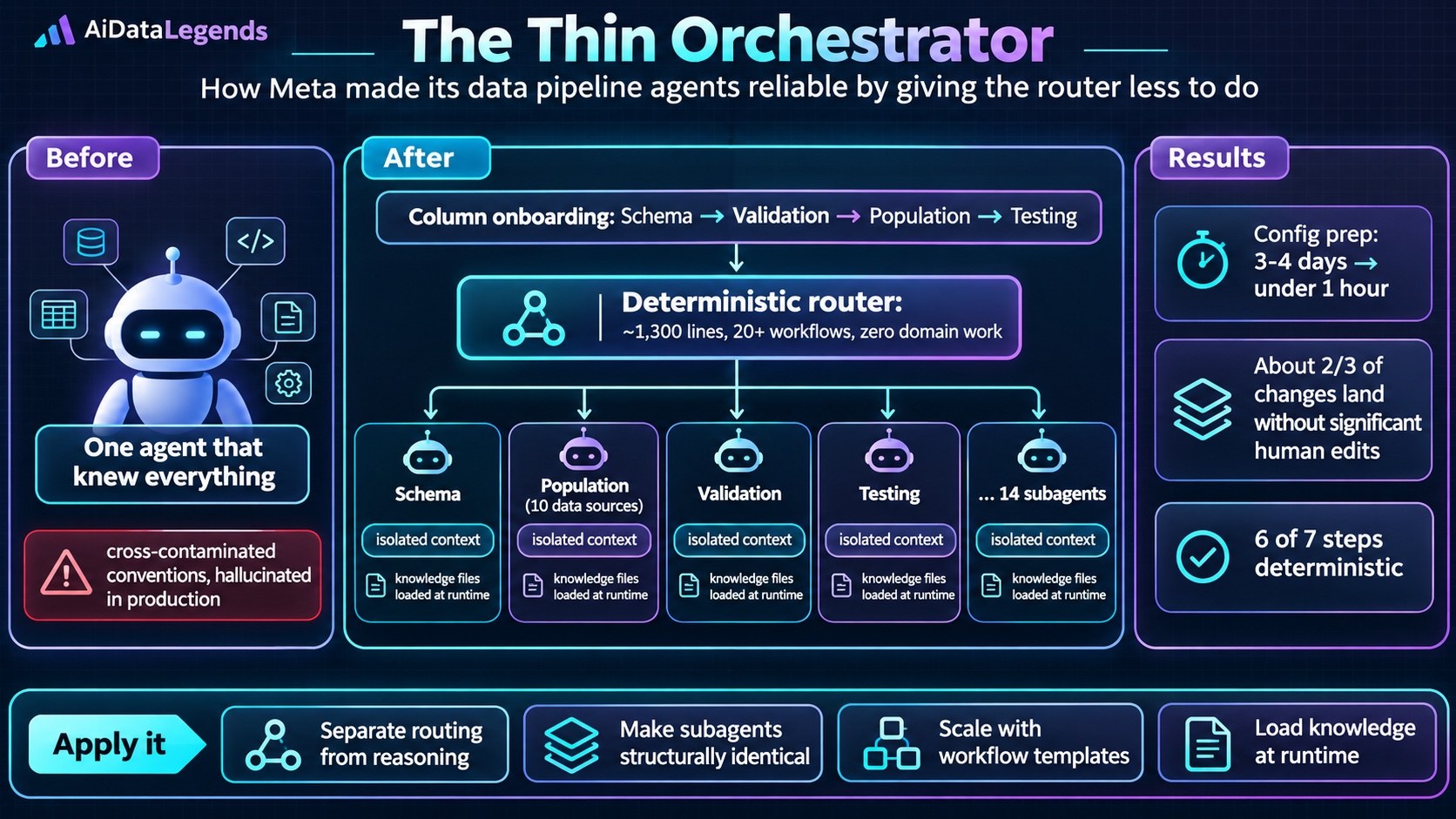
When Meta first used AI agents to automate data column onboarding for its recommendation systems, it did what most teams do: it built one smart agent that knew everything. It worked in demos. In production, it started hallucinating [1]. The fix, Meta’s engineers write, was not better prompts or a bigger context window, but giving the central agent less to do. Their “thin orchestrator” pattern is one of the clearest production write-ups yet on how to structure multi-agent systems.
Why it matters
Onboarding a single column at Meta spans three code repositories, three programming languages and up to six pipeline stages that must stay in sync. The pipeline is config-as-code: Python configurations drive C++ code generation, which feeds data processing services and analytics systems [1:1]. That is the kind of heterogeneous, multi-step work where agent failures are expensive, and where many teams are now trying to apply LLMs.
What went wrong with one big agent
The first agent was loaded with every configuration schema, code generation rule, routing rule, validation requirement and population pattern for more than ten data sources. Past a certain context threshold, more knowledge made it worse. It cross-contaminated concepts, applying one subsystem’s naming conventions to another or using one data source’s code pattern for a different source [1:2].
An alternative single-agent approach succeeded 70 to 80% of the time, but only with a custom system prompt written by an engineer for each task. Without that, success fell to 10 to 20% [1:3]. Meta’s conclusion: this was an architectural problem, not a prompting one.
The thin orchestrator
The redesign has two parts [1:4]:
- A deterministic router, about 1,300 lines, that routes more than 20 workflows. It classifies intent, gathers required fields, runs reliability checks and delegates. It never reasons about code, generates configurations or touches the codebase.
- Fourteen specialist subagents, each with isolated context: a schema agent that knows configuration registries, a population agent that knows code generation for each of ten data sources, a validation agent that knows build systems and quality checks. No agent sees the full picture.
Every request follows a fixed seven-step protocol, from checking whether the target already exists to surfacing results. Six of the seven steps are deterministic; only the execution step uses LLM reasoning, inside a subagent with only its own domain knowledge loaded [1:5].
How it works
Workflow templates. The orchestrator defines what happens in what order through templates that act as deterministic state machines. Column onboarding runs Schema, Validation, Population, Testing; pipeline migration runs Assessment, Planning, Population, Validation, Monitoring. When Meta needed pipeline migration, a new use case, it wrote a new template that reused existing agents: no new agent code [1:6].
Uniform subagents. Every subagent has the same structure: which knowledge files to load, a checklist of inputs the orchestrator must collect first, a step-by-step workflow, patterns for finding relevant code, and error-to-resolution mappings. Adding a fifteenth agent is templated work [1:7].
Knowledge loaded at runtime. More than 25 knowledge files, typically a few thousand tokens each, load when a subagent runs. Updating a file takes effect in the next session without touching the orchestrator [1:8].
What it achieved
Configuration prep for a new column took three to four days by hand, about a day with Meta’s earlier config-driven system, and under an hour with the thin orchestrator. About two-thirds of the system’s changes land without significant human edits [1:9].
Meta also points to a Mount Sinai preprint in which orchestrated multi-agent systems held 65.3% accuracy on 80-task batches where single agents fell to 16.6%, while using up to 65 times fewer tokens [1:10]. That study is from a different domain, so treat it as supporting evidence rather than Meta’s own result.
What data and AI engineers should do
Meta’s own recommendations translate directly [1:11]:
- Separate routing from reasoning. “Which agent handles this?” is a routing decision; do not spend an LLM on it.
- Make subagents structurally identical, so new capabilities are configuration, not architecture.
- Scale with workflow templates first. If you cannot reuse agents across workflows, they are too coupled to use cases.
- Load knowledge at runtime, so updates do not require redeploying the orchestrator.
- Draw the deterministic/probabilistic line explicitly for every component.
Limitations and open questions
Meta does not publish accuracy or latency figures for its own fourteen-agent system beyond the time savings and the two-thirds figure. The post does not say how the router handles requests that fit none of its predefined workflows, or how it catches cases where one agent’s output quietly breaks another’s assumptions. Multi-hop delegation also adds latency compared with one call. And 25-plus knowledge files across fourteen agents are a real maintenance surface; Meta says it is exploring automated feedback loops to propose knowledge updates, with human review gating every change [1:12].
Key takeaways
- One all-knowing agent degraded past a context threshold, mixing up conventions between subsystems. [1:13]
- Meta’s fix is a 1,300-line deterministic router that does no domain work, plus 14 isolated specialist subagents. [1:14]
- New use cases come from new workflow templates over the same agents, not new agents. [1:15]
- Column config prep fell from three to four days to under an hour; about two-thirds of changes land without significant human edits. [1:16]

Discussion
Join the discussion: create a free account or sign in to comment.
No comments yet.